|
Good News is a newsletter written by Bryan Walsh, an editorial director at Vox. He oversees the Future Perfect, tech, climate, and world teams, all of which cover stories that are both important and overlooked. |
|
|
|
Good News is a newsletter written by Bryan Walsh, an editorial director at Vox. He oversees the Future Perfect, tech, climate, and world teams, all of which cover stories that are both important and overlooked. |
|
|
Hey readers,
So — last week was a bit of a departure, but I can confirm we’re returning to regularly scheduled programming today. That means actually good news — the kind you don’t see enough elsewhere.
And in case Good News in good newsletter format isn’t enough for you, I’ll be appearing on Vox’s Unexplainable podcast on Monday to bring you the good news to your ears. You can subscribe to Unexplainable — one of the best science podcasts anywhere — over here.
As always, email me at bryan.walsh@vox.com with questions, feedback, and constructive criticism about my speaking voice. Though, rest assured, I’m well aware of how weird my voice sounds on tape. Read on for:
The world’s most premature baby turns one! 👶 Real-life kryptonite! 🪨 Shiny, happy people?! 😃 |
|
|
The main thing: Extreme weather isn't so deadly |
|
|
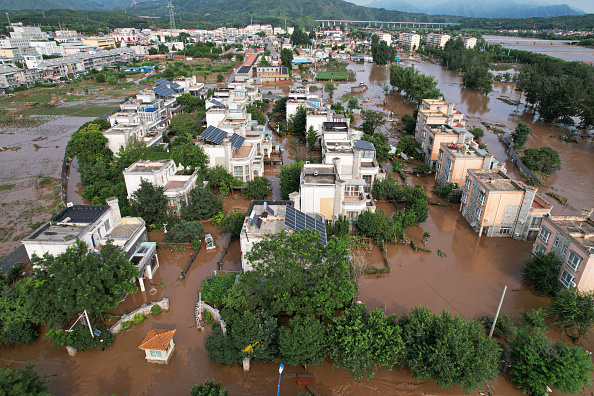
A massive flood outside Beijing in July
Photo by JADE GAO/AFP via Getty Images) |
|
|
From the wildfires that torched Los Angeles in January to the record-setting heat waves that cooked much of Europe in June, the first half of 2025 has been marked by what now seems like a new normal of ever more frequent extreme weather. It’s easy to feel that we live in a constant stream of weather disasters, with one ending only so another can begin, thanks largely to the amplifying effects of climate change.
Yet, behind the catastrophic headlines is a much more positive story. For all of the floods and fires and storms and cyclones, it turns out that, globally, fewer people died from the direct effects of extreme weather globally through the first half of 2025 than any six-month period in recorded human history.
About 2,200 people worldwide died in storms, floods, heat waves, and other “weather‐climate” disasters in the first six months of the year, according to risk consultancy company Aon’s midyear catastrophe report. They tallied 7,700 natural-hazard deaths overall, but if you take out the roughly 5,500 people who died in a single non-weather geological event — a major earthquake in Myanmar in March — you’re left with the smallest January-to-June weather death toll since we began keeping records. (Hat tip to Roger Pielke Jr., whose Substack post was where I first saw these figures.)
More than 2,000 deaths is still too many, and it doesn’t count more recent deadly disasters, like the terrible July floods in Texas’s Hill Country that killed at least 135 people. But it’s still remarkably low. The world has averaged 37,250 deaths in the first half of the year so far in the 21st century, and in previous centuries, far larger numbers of people often died because of extreme weather. Somehow, even as climate change has intensified many natural disasters and more people are living in harm’s way, the actual human toll from these catastrophes has been falling.
All of that raises two questions: How have we managed this? And will this trend continue even in an ever-warmer world? |
|
|
I’ve been writing this newsletter for a few months now, and if I were to boil down its message into one phrase, it’d be, "Wow, the past was much worse than you think."
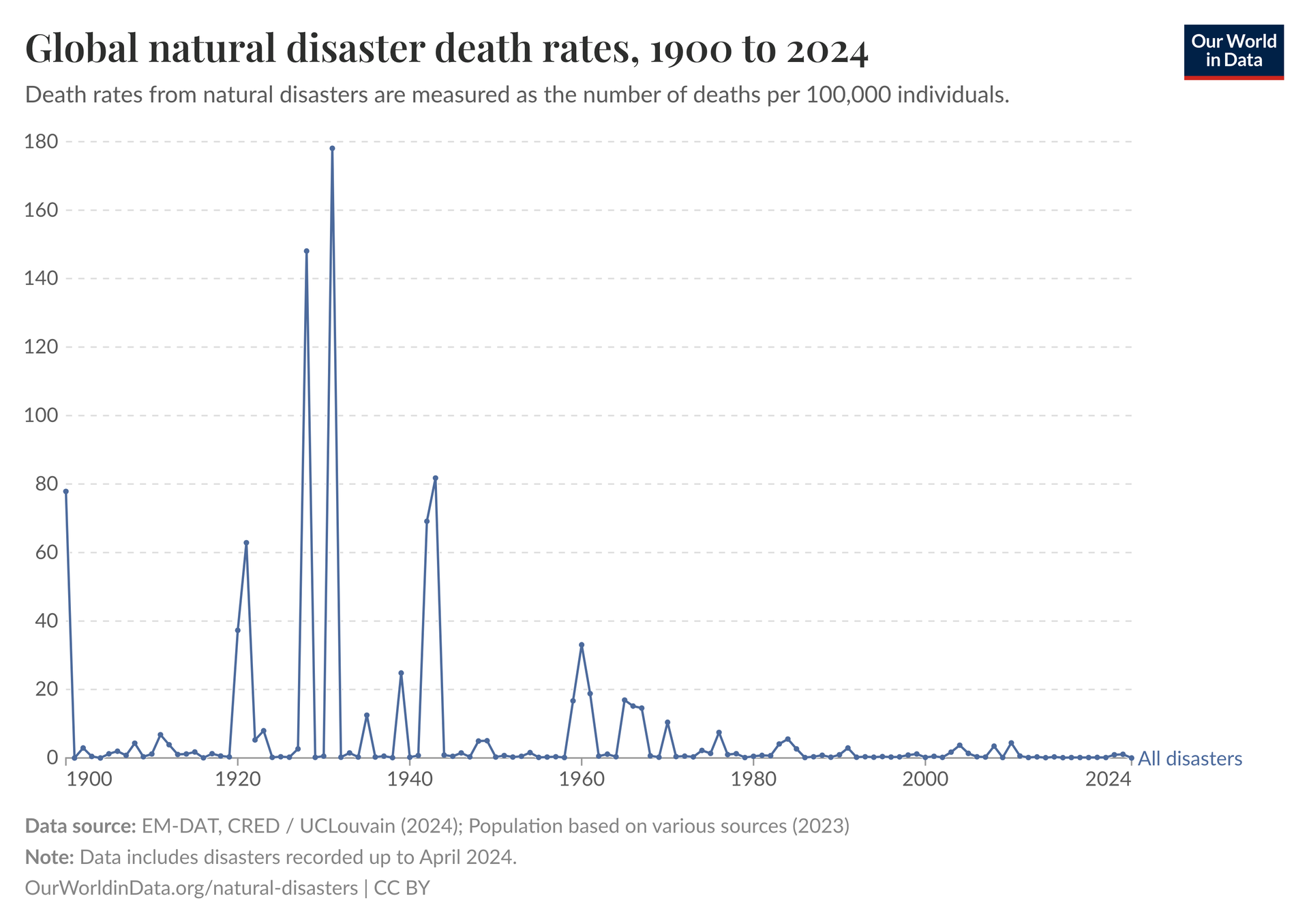
That’s certainly the case for deadly natural disasters and extreme weather. As you can see from the chart above, the first half of the 20th century regularly had years when the death rate from natural disasters was as high as 50 deaths per 100,000 people — and sometimes far higher. (In 2024, it was just 0.2 deaths per 100,000 people.) But annualized death rates hide just how bloody some of these events were.
In 1931, massive flooding in China’s Yangtze River and Yellow River killed perhaps 4 million people due to drowning, disease, and starvation. In 1970, a huge cyclone in Bangladesh killed 500,000 people, and perhaps far more. An earthquake that hit Tokyo in 1923 killed at least 143,000 people. Here in the US, a hurricane that hit Galveston, Texas, in 1900 killed as many as 12,000 people, making it the deadliest natural disaster in US history.
Until fairly recently, the Earth was a merciless killer. The 21st century has still been marked by the occasional mega-death-toll disaster — most of them earthquake related rather than weather-driven — but they’ve become far rarer. The frequency of storms and floods hasn’t abated. The difference is our ability to protect ourselves.
|
|
|
There’s a paradox in our improving response to natural disasters: Even as the deaths from extreme weather and other catastrophes have been falling, the cost of those events has been rising. The same Aon report that contained the good news about falling deaths also tallied up an estimated $162 billion in economic losses from global natural disasters — some $20 billion above the 21st century average.
These two trends are deeply connected. The single biggest factor behind the sharp increase in the economic costs of extreme weather is the simple fact that the world keeps getting richer and richer. That means more and more expensive property is at risk every time a hurricane spins up in the Atlantic or a flash flood swamps a major city. Yet, at the same time, a richer society is one that can invest in warning systems and infrastructure adaptations that can and do vastly reduce the death toll from a disaster. Property in the path of a storm can’t move, but people — if they’re warned in time — can.
Take the terrible Los Angeles wildfires. The total economic impact from the fires may be as high as $131 billion, which would make it one of the costliest disasters in US history. That shouldn’t be surprising; the fires ripped through some of the most valuable real estate in the country. The death toll, by contrast, was 30 people. That makes it the second-deadliest wildfire in California history, but it still had a far lower human toll than wildfires from a hundred years ago or more, which killed hundreds and even thousands of people.
It’s a basic rule of disasters: A richer society has more to lose in property, but it also has the wealth to protect its people. And property, unlike people, can be restored. |
|
|
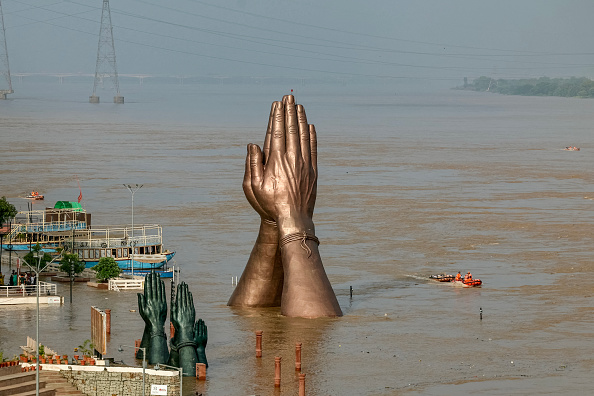
Floods in India on Aug. 1 Photo by NIHARIKA KULKARNI/AFP via Getty Images |
|
|
From early warning text chains in Mozambique, to cyclone shelters in Bangladesh, to heat action plans in India, even some of the poorest countries in the world have built warning and response systems that can blunt the death toll of the worst extreme weather. The question for the rest of the decade is whether we can protect livelihoods as well as lives.
A new UN report estimates that when the full effects are counted, disasters cost the world over $2.3 trillion every year. We are getting brilliantly good at saving people. We have not yet figured out how to save their homes, crops, and jobs. That will require the hard, unglamorous work of preparing for disasters before they happen. It’s an investment that should pay off — that same UN report calculates that every dollar spent on risk reduction leads to at least four dollars in avoided losses.
Extreme weather and natural disasters have always been with us and always will be, and climate change will mostly make them worse. But we shouldn’t lose sight of one of humanity’s greatest triumphs: We are learning, year by year, how not to die when the planet turns against us. The arc of human ingenuity still bends toward safety. |
|
|
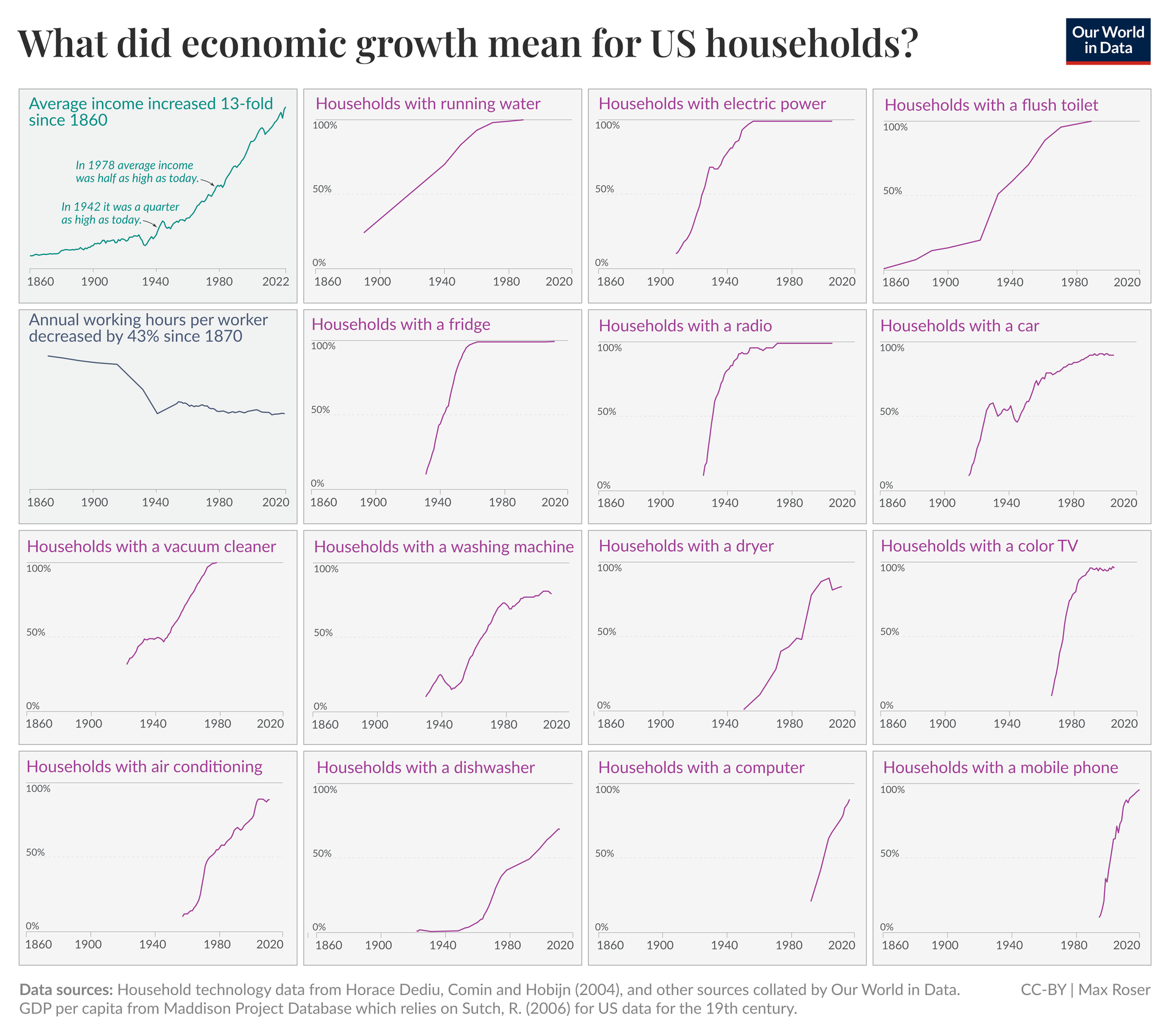
What does economic growth buy? At the great Our World in Data, Max Roser’s “160 Years of U.S. Growth” grid answers that question in a glance. The average American was 13 times richer in 2022 than they were in 1860 — and Roser turns that abstraction into life by demonstrating what that extra wealth buys. Chart after chart shows the share of households with running water, flush toilets, electricity, radio, TV, internet, mobile phones, vacuum cleaners, washing machines, dryers, and dishwashers rockets from almost zero to nearly all.
The pairing nails a tricky idea: income curves feel remote, but goods-in-your-home curves are visceral. Side by side, they show economic output translating into cleaner kitchens, lighter laundry, and instant conversation. Practical progress, condensed into 16 tiny panels, makes an irresistibly clear case for why economic expansion, though hard to see day to day, has quietly upgraded truly ordinary lives for most Americans. |
|
|
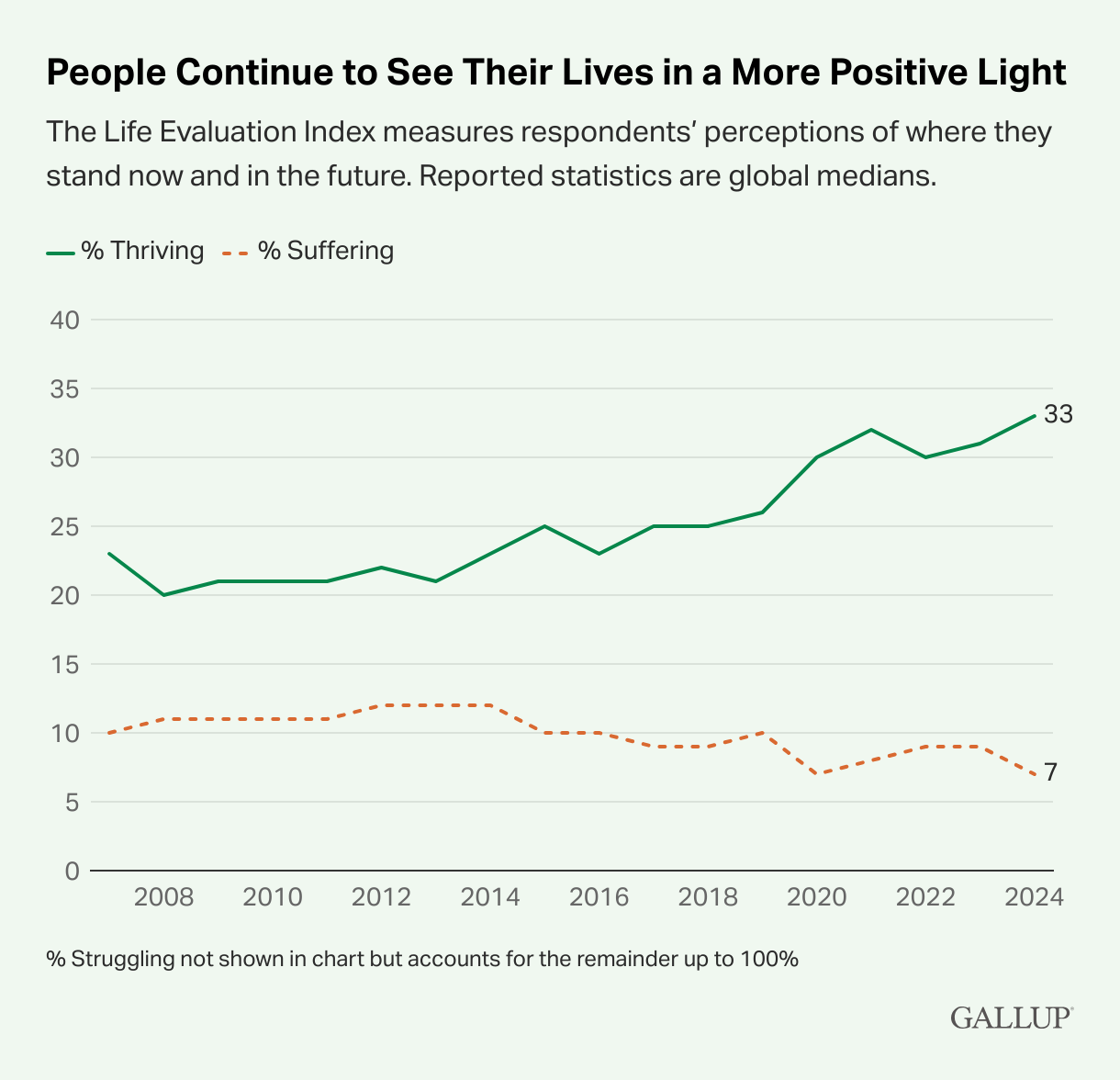
Everything is…awesome? That’s not the obvious tenor of life in the year 2025, but Gallup’s latest Life Evaluation Index flips the doom-scroll script. The global survey tracks how many adults judge their own lives as “thriving.” In 2024, that share hit 33 percent across 142 countries — up steadily from single digits in the late 2000s. At the other end of the scale, the slice who say they’re “suffering” has slipped to just 7 percent, tied for the lowest on record going back to 2007.
In other words: Despite constant headlines about crises, wars, and malaise, one in three people now look at their life and give it a solid thumbs-up, while only a sliver offer a despairing thumbs-down. The quiet rise of everyday optimism is easy to miss in the 24-hour outrage cycle — and reported well-being has been falling in regions like the US, Canada, and Western Europe — but this chart makes it impossible to ignore. Turns out the global mood is brighter than the comment section suggests.
|
| |
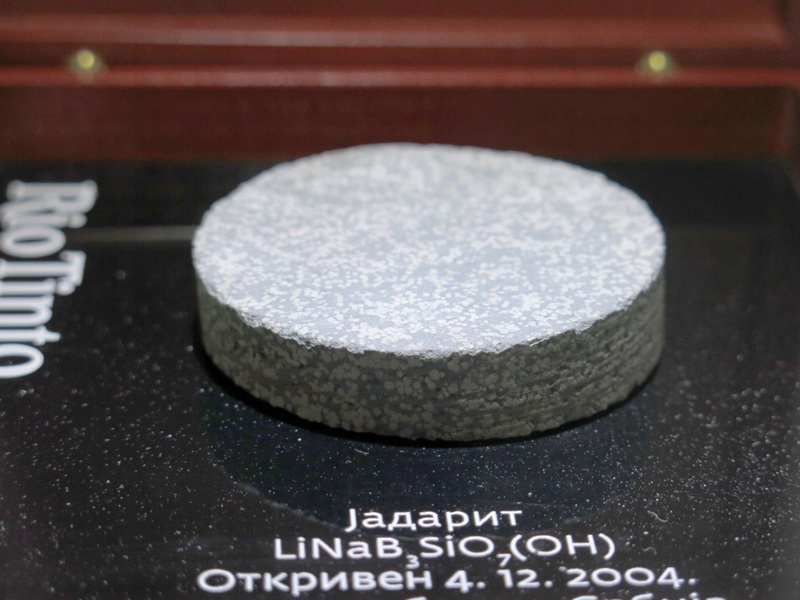
A sample of jadarite
Credit: Wikipedia Commons |
|
|
Superman’s loss is our battery’s gain. Scientists have confirmed that jadarite — the real-world mineral whose chemical makeup mirrors comic-book kryptonite — could be key to making better batteries in the future. Found in Serbia’s Jadar Valley, jadarite is a chalk-white (not green) rock that flashes a pink glow under UV light, and crucially, is packed with lithium and boron.
Those two elements happen to be the beating heart of rechargeable batteries and heat-resistant glass, and the Jadar deposit is counted among the world’s largest lithium troves. Translation: This analogue to the mineral that weakens Superman could super-charge the clean-energy transition — powering electric cars, grid storage, and maybe your next phone. |
|
|
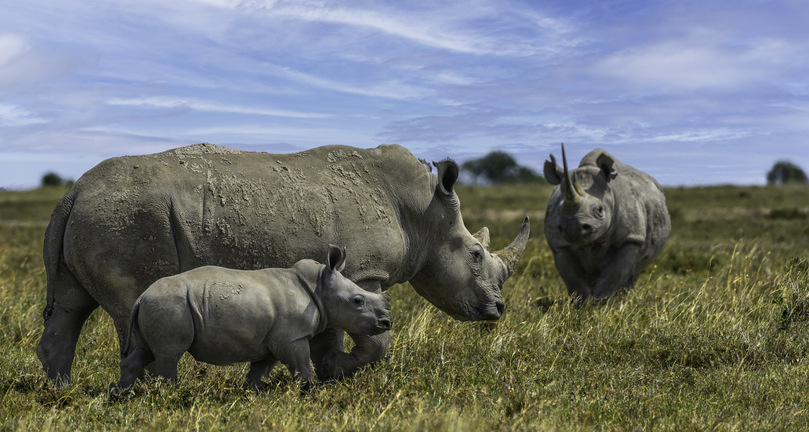
And baby makes three Credit: Getty Images |
|
|
-
IVF breakthrough for rhinos: Scientists have pulled off the first successful embryo transfer in any rhino, implanting a lab-made southern-white embryo that took hold on the thirteenth try. The proof-of-concept clears the path to use frozen northern-white embryos next — vital when only two animals remain alive. It’s a giant step toward reversing a man-made extinction.
-
Alzheimer’s “plaque vacuum”: Early trial results for the antibody drug trontinemab are jaw-dropping. 90 percent of patients had Alzheimer’s plaques completely cleared in just 28 weeks, with fewer than 5 percent experiencing mild, temporary side effects. The treatment needs only monthly infusions, making large-scale, preventative use plausible — and cheap enough for public health systems to cover.
-
Anti-drugging tattoos: Korean chemists have turned a temporary skin tattoo into a one-second GHB detector. Dip a finger in your drink abd touch the sticker, and it'll flash from yellow to red if the “date-rape” drug is present — faster than any strip or coaster on the market. The disposable sensor costs pennies and should hit shelves soon.
-
A birthday for a record-setting baby: Nash Keen was born at 21 weeks and a feather-light 0.62 lbs. He’s now a giggling one-year-old — the most prematurely-born baby ever to reach that milestone. Six months of cutting-edge NICU care let him trade ventilators for birthday cake, showing how far neonatal medicine has stretched viability in a single generation.
|
|
|
📲 Did I miss any good news? Share story ideas and feedback to bryan.walsh@vox.com. For additional thoughts, follow me on X and don't forget to check out the latest from Future Perfect.
|
|
|
|