|
Good News is a newsletter written by Bryan Walsh, an editorial director at Vox. He oversees the Future Perfect, tech, climate, and world teams, all of which cover stories that are both important and overlooked. |
|
|
|
|
Good News is a newsletter written by Bryan Walsh, an editorial director at Vox. He oversees the Future Perfect, tech, climate, and world teams, all of which cover stories that are both important and overlooked. |
|
|
|
Hey readers,
Sometime in the second century BC, a Greek Stoic philosopher sat down and wrote out his thoughts on human nature, self-control, and what he called the moral progress of human beings. Then, in 79 AD, Mount Vesuvius buried the Roman town of Herculaneum, where the book was kept, under dozens of feet of volcanic rock. For nearly two thousand years it waited, a charred, cigar-shaped lump of carbon that would crumble to dust the instant you tried to unroll it.
Last month, we read it anyway. |
|
|
|
On June 25, a team with the Vesuvius Challenge read an entire Herculaneum scroll from beginning to end without ever opening it. They scanned the rolled-up layers with a synchrotron, and then turned machine-learning models loose to find ink almost the exact color of the burnt page. The lost libraries of antiquity may be lost no longer.
We often assume the past was richer and wiser and sturdier than the present, that we've been coasting downhill from some earlier golden age. And yet here the deep past was literally unreadable to everyone who came before us, and it took our most modern tools to get it back. The good old days are almost always harder to make out than we remember — and almost never as we remember them. Which brings me to this week's main piece, about a golden age that turns out to be mostly a trick of memory: the 1990s, and the teenagers of today who, by nearly every measure that counts, are doing better now than we were then.
As always, email bryan.walsh@vox.com with comments, questions, and the one thing from the '90s you'd actually bring back. Read on for: A pencil-tip eye implant! 👁️
The forest that ate New England! 🌳 Faster ambulances! 🚑 But first… |
|
|
The main thing: The teen crisis America actually solved |
|
|
|
Gideon Mendel/Getty Images |
|
|
|
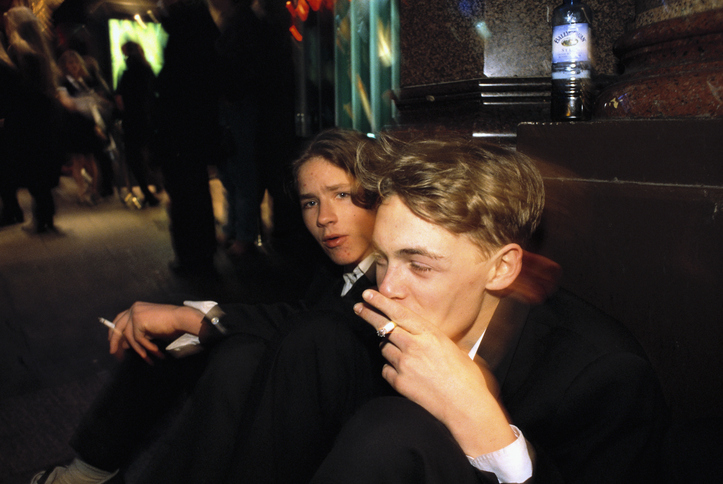
It’s been feeling very 1995 lately.
Oasis, whose last good song came out back when Macs were still see-through, was the second-biggest tour on the planet last year. Gen Z is snapping up the flip phones and digital cameras their parents had traded in for smartphones, and Y2K-era fashion is flooding the mall, in case you were wondering where all the rhinestones came from. Pop star Olivia Rodrigo just released a hit album heavily influenced by alternative rock recorded a decade before she was born.
Ask Americans directly and they'll tell you: the 1990s are the decade we're most nostalgic for, edging out even the boomer-beloved ’80s.
Speaking as someone who lived through the 1990s as a teenager and mostly enjoyed it (at least in retrospect), it makes total sense to me. Of course, it would — as a Washington Post analysis found, when Americans name the country's "best decade," the answer inevitably boils down to whichever decade they turned 11.
But personal experience also means that, with a little effort, I can remember what the 1990s were actually like to live through, and the reality was a different story than the myth — especially for teenagers of that era.
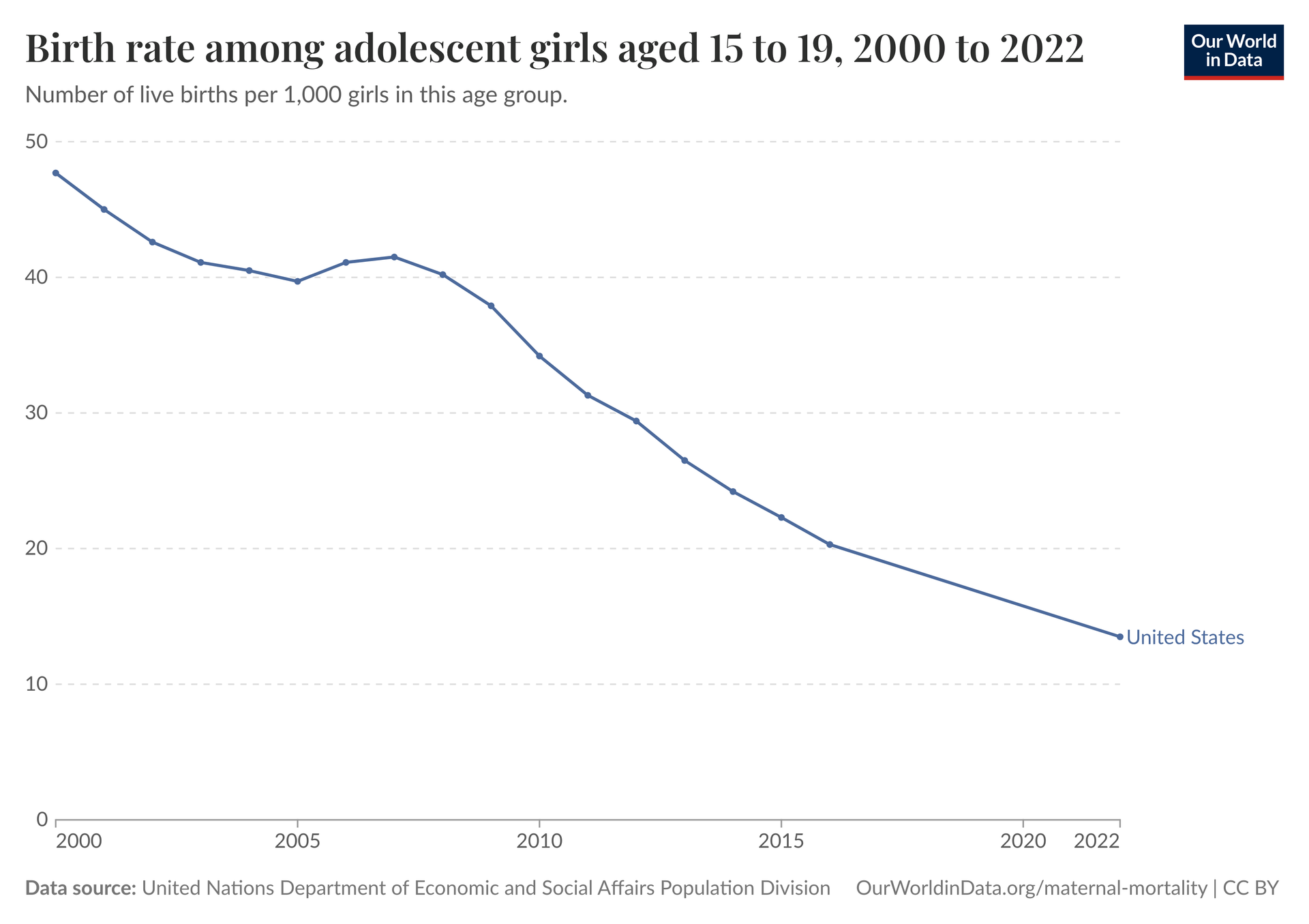
Take teen pregnancy. In 1991, the teen birth rate hit a record high of 61.8 births per 1,000 girls aged 15-19. In his 1995 State of the Union address, President Bill Clinton called “the epidemic of teen pregnancies and births where there is no marriage” America’s “most serious social problem.” A National Campaign to Prevent Teen Pregnancy formed the following year in direct response.
And the fear ran well beyond pregnancy: juvenile arrests peaked in 1996 at nearly 2.7 million, at the height of the so-called “superpredator” panic over a coming wave of remorseless teenage criminals. In 1995, as the writer Adam Mastroianni points out in an excellent new essay that helped inspire this piece, half of high school students drank alcohol, 35 percent smoked cigarettes, 40 percent had at least tried marijuana, one in 10 had brought a weapon to school at some point, and about 6 percent of teenage girls were pregnant in any given year. The teen suicide rate for boys hit a record high in 1990. Americans were terrified for their teenagers, and terrified of them.
So, no, the 1990s weren’t all teen boy bands, high school comedies, and endless economic growth. But what’s amazing, at a moment when everyone seems sure that kids today are not all right, is just how much those scary signs of teen dysfunctions from the 1990s have simply vanished.
This spring, the CDC reported that the US teen birth rate fell to 11.7 births per 1,000 girls ages 15 to 19 in 2025 — down 81 percent from its 1991 peak, and the lowest figure ever recorded. That has been the pattern for more than three decades now: the teen birth rate sets a record low, then breaks it, then breaks it again.
It’s not just teen pregnancy: nearly every risky teen behavior of the halcyon 1990s started collapsing almost at once, kept collapsing for 30 years, and is collapsing still. The teen birth rate dropped 7 percent in 2025 alone. And yet it’s hard to find anyone who planned this victory, and nearly impossible to find anyone who celebrated it. |
|
|
Let’s start with teen births, which largely comes down to two factors working in concert: fewer teens are having sex, and those who are use much better contraception.
The share of high schoolers who have ever had sex fell from 54 percent in 1991 to 32 percent in 2023, and Guttmacher Institute researchers found that improved contraceptive use drove essentially all of the pregnancy decline in the late 2000s and early 2010s, including a sevenfold rise in teens using long-acting IUDs and implants. In the decade that followed, delaying sex became the biggest single contributor.
But contraception can’t explain why violence fell too. The best unified theory comes from psychologists like Jean Twenge and more recently writers like Mastroianni, whose “Decline of Deviance” essays argue that kids stopped taking risks of all kinds in part because their futures became too valuable to gamble. As lives got longer, safer, and richer, the expected cost of any given joint, fight, or pregnancy went up. Twenge called this the “slow life strategy,” and it shows up as much in data about taking good risks as it does in taking bad ones: the share of high school seniors with a driver’s license, for instance, fell from 82 percent in 2005 to 63 percent in 2023.
If you’re waiting for smartphones to enter the picture, you’re going to keep waiting — most of these trends began in the 1990s, long before broadband, let alone Instagram. And policy didn’t seem to do much either. England spent hundreds of millions of dollars on a national teen pregnancy strategy, and a comparative analysis found rates fell about as fast as they did in similar countries that spent nothing. (Researchers have found that one of the few interventions with credible causal evidence behind it, at least in the US, was MTV’s iconic 16 and Pregnant — a reality show that worked by making teen parenthood look as exhausting as it was in reality.)
|
|
|
Luke Frazza/AFP via Getty Images |
|
|
|
Everything everywhere at once |
|
|
|
The same collapse in dangerous behavior shows up everywhere you look. Half of high school students drank alcohol in 1991; 22 percent did in 2023. Seventy percent had tried a cigarette in 1991; under 18 percent had by 2021 — and no, they didn’t all just switch to vaping. E-cigarette use has also been falling since 2019. The share of high schoolers who’d been in a physical fight in the past year dropped from 42.5 percent in 1991 to 22 percent by 2019. And this year’s Monitoring the Future survey found that 66 percent of 12th graders — a record — used no alcohol, marijuana, or nicotine at all in the past month.
For me, no number stands out more than marijuana. When I was a teen in the 1990s… well, when I was a teen in the 1990s I was way too uncool to know anyone who had marijuana. (Honest, Mom.) But weed is now legal for adults in half the country, almost certainly easier for a teenager to obtain than at any point in American history, and generally regarded by young people as less dangerous than their parents ever believed. Yet even as marijuana use has spiked among adults, it has fallen among teens from its late-1990s peak.
All that caution shows up in the most basic stat there is: teenagers stopped dying so frequently. In 1990, 88 of every 100,000 Americans ages 15 to 19 died each year; by 2013 it was 45. The single biggest reason was the car: since 1975, teen road deaths have fallen 67 percent thanks to safer vehicles, the graduated licensing laws every state adopted starting in the mid-1990s, and all those teens who never bothered getting a license in the first place. At the 2013 low, an American teenager was half as likely to die as one in 1990.
That last stat is worth holding onto. Nostalgia isn’t just misleading; it also suffers from survivorship bias. Adults like myself may look back on their 1990s adolescence as a golden age, but there are tens of thousands of my peers who never lived to look back. |
|
|
The problem with reducing risk-taking behavior across the board is that not all risks are bad. The same caution that might keep a 16-year-old from smoking or having sex might later keep her from founding a company, moving across the country, or writing a strange novel. In Mastroianni’s “Decline of Deviance” essays he documents falling cultural and scientific risk-taking right alongside fewer fistfights. “For the first time in history,” he writes, “weirdness is a choice. And it's a hard one, because we have more to lose than ever."”
And if teens are so safe, why are they so sad? Forty percent of high schoolers reported persistent sadness or hopelessness in 2023, and the social psychologist Jonathan Haidt has argued that we’ve overprotected kids in the physical world while underprotecting them in online spaces that didn’t even exist in the dial-up 1990s. The timing backs him up: when the CDC first asked the sadness question in 1999, about 28 percent of students said yes, and the number barely moved for nearly two decades until surging after 2017. Physical safety and psychological well-being may turn out to be more separate than we ever realized.
But our valid worries about the mental state and uncertain future of today’s teens shouldn’t blind us to just how remarkable the shift from the 1990s is as a whole. As Mastroianni writes, “We would have spent billions to solve all of these problems back in the 1990s... and yet when we got the thing we wanted so badly, we didn't even notice."
America wanted its teenagers to stop getting pregnant, stop smoking, and stop fighting — wanted it badly enough to put it at the center of a State of the Union address — and then got nearly all of it, mostly free of charge, from the kids themselves. “Can we take a win?” Mastroianni asks. We can start by counting this one. |
|
|
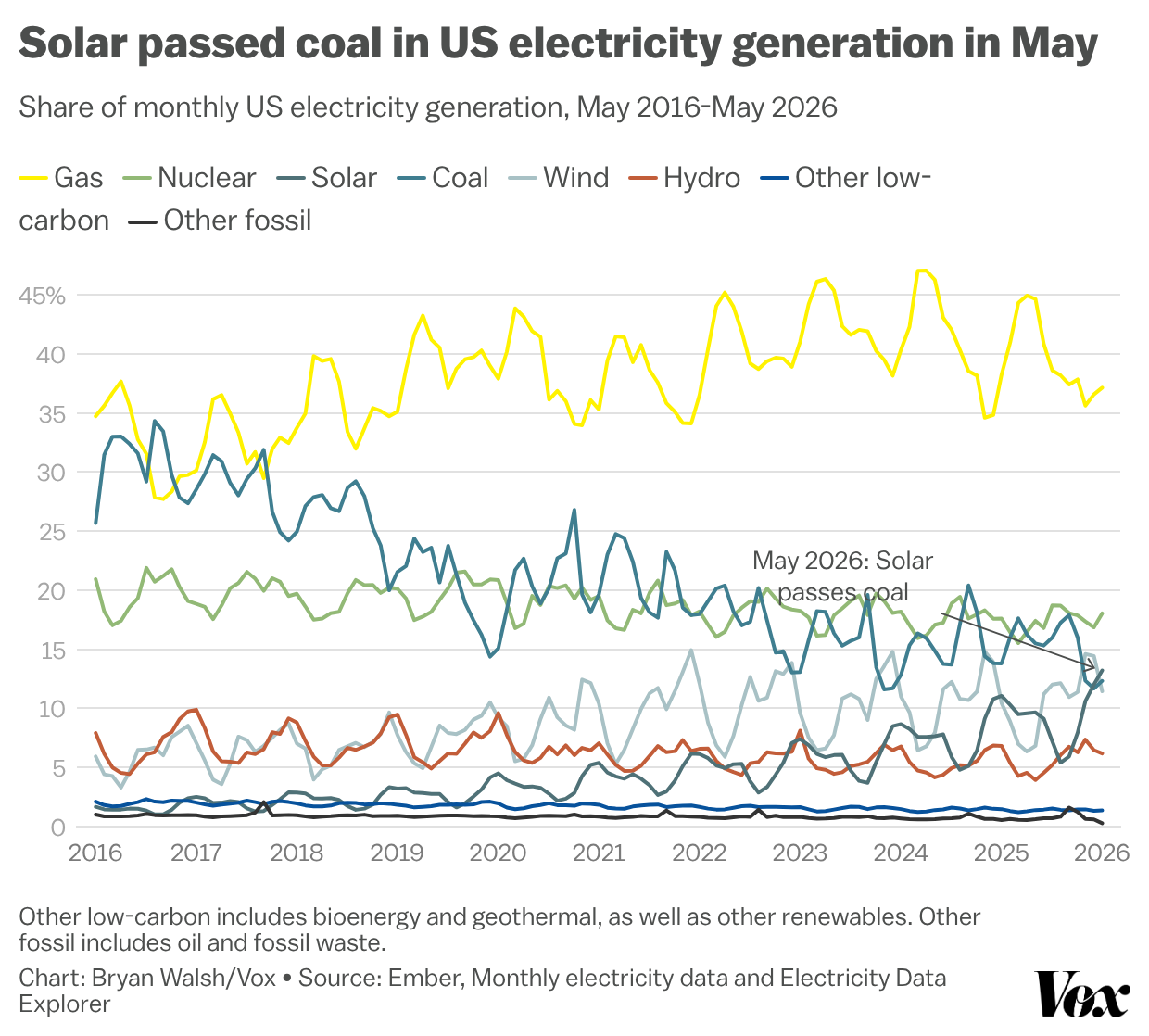
For a century, coal was the workhorse of the American grid — the black rock that powered the factories, the air conditioning, the suburbs. But in May, for the first month ever recorded, solar power out-powered coal. US solar produced 45.5 terawatt-hours that month, an all-time high and up 17 percent from a year earlier, just enough to edge past coal in the national mix for the first time on record.
Some of that is seasonal — May sits close to solar's peak and coal's low, so across a full year coal still generates more. And this particular milestone arrived even as the current administration works to prop coal back up. But with solar now the cheapest new electricity in most of the world, the crossing that happened once in May will keep happening, for longer stretches, every year on.
|
|
|
-
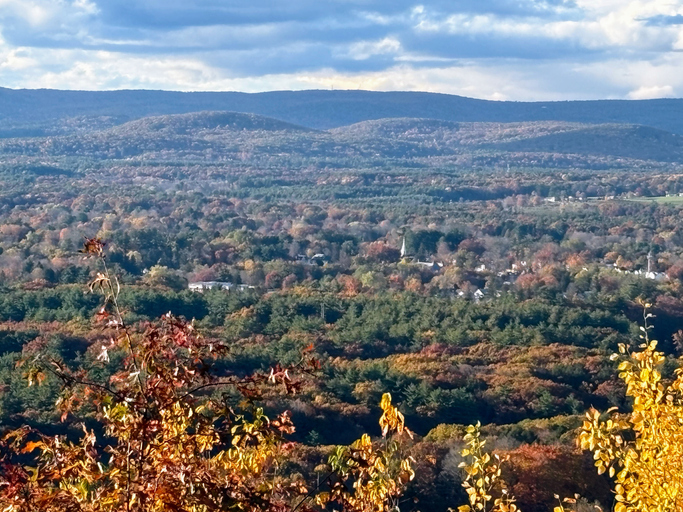
Massachusetts goes green: By the end of the 1800s, farms and railroads had stripped Massachusetts of up to 90 percent of its trees. Today the third-densest state in the country is about 60 percent woods — one of the greatest forest recoveries in the world, per Inside Climate News. The cause was mostly benign neglect: farmers quit the rocky soil for the Midwest, and the forest took it back.
-
Eye spy: A retinal chip the size of the letter O is restoring central vision to people blinded by macular degeneration. In a trial published in the New England Journal of Medicine, 26 of 32 patients who finished a year were using the implant, called PRIMA, to read at home, gaining about five lines on the eye chart. It’s narrow and black-and-white, but they can read again.
-
Clearing the way for ambulances: After New York started tolling drivers below 60th Street, there was a lifesaving benefit, according to a new working paper from the National Bureau of Economic Research. Inside the congestion zone, EMS crews now reach patients 63 to 70 seconds faster — about 5 to 6 percent — as traffic fell by about a fifth. That's real time in a heart attack.
-
AI cuts red tape: New York Gov. Kathy Hochul's Regulatory Reset ran an AI tool across 18 million words of state statute and turned up the fossils: more than 350 rules still demand a fax or a telegram, plus a nine-member council on the state of sour cherries and an unconstitutional McCarthy-era report on "subversive" schoolteachers. Clearing it could save New Yorkers a million hours of paperwork a year.
|
|
|
📲 Did I miss any good news? Share story ideas and feedback to bryan.walsh@vox.com. For additional thoughts, follow me on X and don't forget to check out the latest from Future Perfect.
|
|
|
|
|