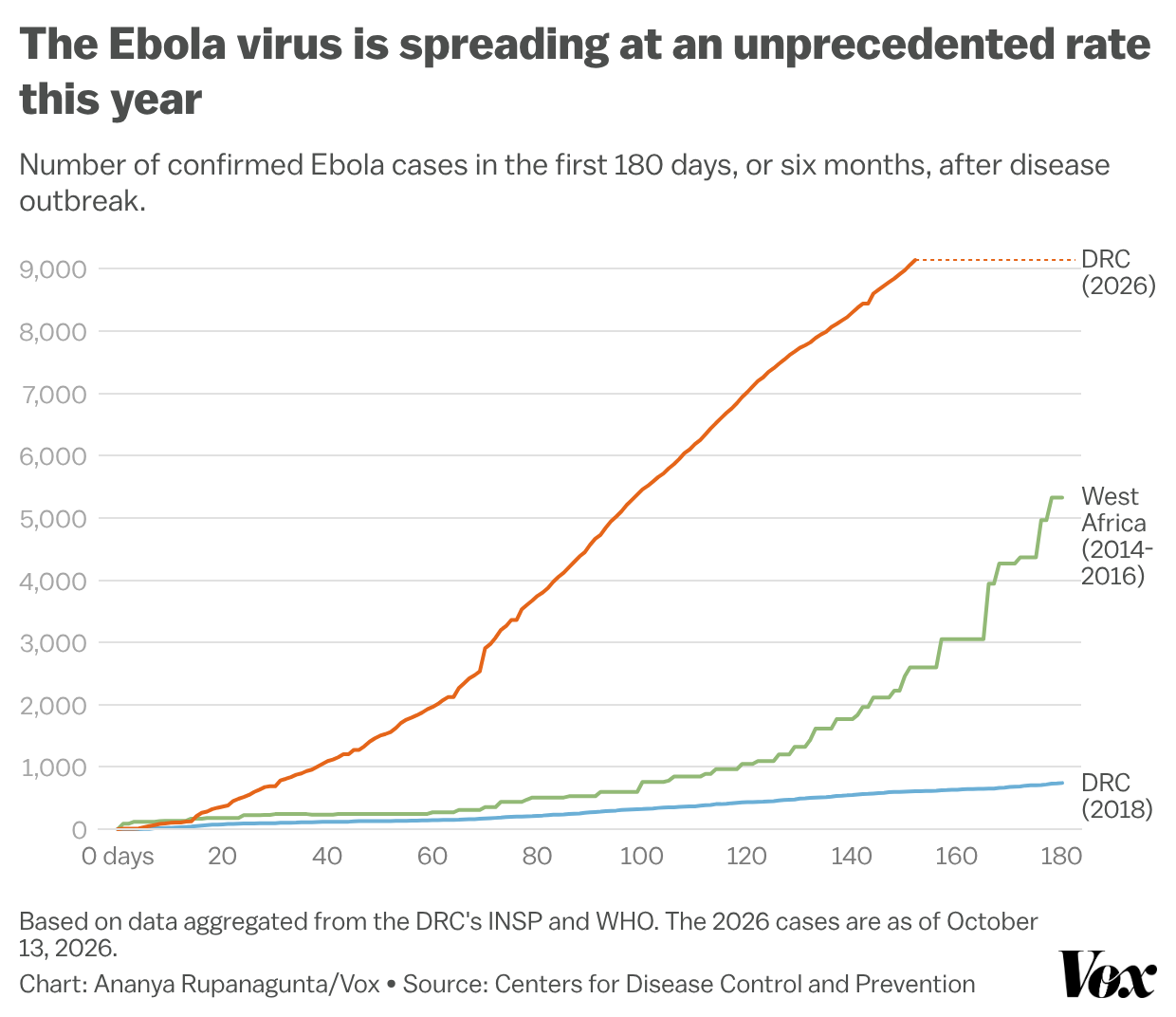
No previous Ebola outbreak has grown this quickly.

View this email in your browser   

👋  Did this email get forwarded to you? Sign up here to get Future Perfect in your inbox every Wednesday.

Future Perfect

Hey readers,

Ananya here. 


The Ebola virus is spreading at an unprecedented rate this year. 


In the first five months since the outbreak began in the Democratic Republic of Congo (DRC), the World Health Organization (WHO) has reported 9,415 confirmed cases and 4,536 deaths in the country. While the virus has remained relatively contained by the DRC’s borders, case counts in neighboring Kenya and Uganda are also climbing (albeit more slowly). There are 20 confirmed cases in Uganda and eight in Kenya, and much of central and eastern Africa has tightened its borders. 


The last major Ebola epidemic of this scale began in 2014 and continued through 2016 in West Africa. Over that period, it ultimately killed more than 11,000 people throughout West Africa. Nearly four years later, a smaller outbreak plagued Congo in its North Kivu region, leading to 2,229 deaths before it was contained. 


The 2026 crisis hasn’t yet reached the same levels as the 2014 outbreak, but the speed of its spread is far greater. 


As the chart below shows, around 150 days after the outbreak was declared, 2,599 Ebola cases had been reported in the 2014 West African epidemic. At the same time point this year, the number of cases came to 8,978 and has continued to climb. 

There is no straightforward explanation for this rapid spread


One of the reasons the latest epidemic has been so difficult to slow down can be traced back to the fact that it’s a different viral strain — known as Bundibugyo — than the ones behind previous epidemics.  


The Bundibugyo virus comes from the same family as the Ebola virus that caused the 2014 West Africa and 2018 Congo epidemics, causing the fatal fevers associated with Ebola. But the rare strain is different enough that it doesn’t respond to the same medical solutions. While the Zaire virus led to vaccines and treatment to mitigate the spread, we still don’t have a vaccine for Bundibugyo. 


That doesn’t mean Bundibugyo is entirely novel, though. The 2026 outbreak is the third outbreak related to the Bundibugyo viral strain: In 2007, Uganda faced a minor outbreak, and the eastern province of Congo, which is now the epicenter of the epidemic, saw a handful of cases in 2012. 


Luckily, these two outbreaks were contained in a span of months, largely due to efforts by the country’s Ministry of Health and international aid partnerships with the WHO, the US Agency for International Development (USAID), and international humanitarian organizations such as the UN Children’s Fund and Red Cross.


More than a decade later, these efforts have been substantially curbed by USAID cuts. Tracing requires physical testing capacity: the tests themselves, health workers, and protective equipment for those treating suspected cases. Reduced access to such resources is especially dangerous with strains like Bundibugyo – in the absence of an effective vaccine, tracing the spread of disease and isolating potential disease contacts is especially important. 


But cuts to aid, which covers disease surveillance efforts, made it more difficult to identify this year’s Bundibugyo outbreak until it was too late, creating a “critical four-week detection gap between the onset of symptoms of the presumed index case
and the laboratory confirmation of the outbreak,” according to a WHO situation report from May. 


In August, the United States aimed to close at least some part of the vacuum it left, providing an additional $242 million to its $23 million original pledge in May. 


Aside from international efforts, DRC faces the added layer of internal conflict and humanitarian crisis. The eastern provinces, including Ituri, have experienced years of conflict that have weakened the public infrastructure, including the healthcare system. Last year, nearly 25 percent of Congolese people faced food insecurity, and 4.5 million children were clinically malnourished, creating a population especially vulnerable to disease. The violence has also overwhelmed hospitals and displaced millions, disrupting the public health response, especially as mistrust in health authorities also runs rampant. 


Even as emergency trials for a vaccine are underway, many of the factors that have facilitated the rapid spread may make treatment and outreach still more difficult. It’s hard to predict when the current outbreak will be handled, and how many more people will be affected before it does. 

Ananya Rupanagunta

Future Perfect fellow

Ananya Rupanagunta

Future Perfect fellow


CAN'T STOP THINKING ABOUT...

with Sara Herschander


Title: Reporter
What I cover:  Infrastructure, and how to build nice things (sign up for my newsletter!)
My latest geonerd obsession: MapTap (99đŸ”„ 97đŸ”„ 98đŸ”„ 96đŸ”„ 85😁 Final score: 935)

In between filling potholes, expanding free daycare seats, and approving fancy new sidewalk sheds, New York City Mayor Zohran Mamdani announced a new plan last Wednesday that has been breaking my brain all week: a $30 million investment in quantum computing, an emerging field of research that uses advanced physics to make computers exponentially more powerful in ways that could ultimately help us uncover the secrets of the universe, or at least make for far more accurate and prescient weather predictions. 

In return for investing the cash upfront, the city will receive 15 percent of the proceeds from any intellectual property developed in NYU’s new Quantum Technology Lab, a sort of private-public economic development model that is very common for spurring both innovation and municipal revenue in places like China, but is still highly unusual in the US. Historically, this country has preferred to incentivize innovation through tax breaks instead, with the understanding that new tech will bring new jobs and more revenue in the long run. 

But there are signs beyond the five boroughs that this is changing. Earlier this year, the Trump administration pledged $2 billion to several quantum-computing firms in exchange for equity in their products, and according to the conservative Cato Institute, the administration now has an overall corporate portfolio of 30 companies and counting across a variety of industries.

What these two surprisingly cordial sons of Queens appear to have in common is a conviction that the government ought to hold more sway over how the next generation of cutting-edge technology gets built and who profits from it. To me at least, that sounds like a pretty worthy use of my tax dollars.

Meet us on Patreon!

The Vox Membership program is getting even better with access to Vox’s Patreon, where members can unlock exclusive videos, livestreams, and chats with our newsroom.

Become a Vox Member to get access to it all.

JOIN VOX ON PATREON


THE BIG STORY ➠

AI can help us talk with the dead. Should we?

How “deadbots” might reshape grief. 

After her friend died at a young age, Lissa Soep yearned to talk with her again. So she fed things her friend had written into a chatbot — and started a conversation. 

AI now makes it possible to create a relatively believable simulacrum of an individual, whether that person is still alive or not. And companies are already starting to offer these “deadbots” to people who yearn to keep talking with loved ones they have lost. What could possibly go wrong? 

In a recent episode of Vox’s Unexplainable, Lissa talks with researchers who are traveling the world to better understand the many thorny ethical issues that could arise, and how they might be met and handled in different cultures. What happens when a company providing you with a chatbot of your dead grandmother goes under — or when they start using her likeness to try to upsell you on something? How would all of this shape your grief? —Katherine Courage, deputy editor, Future Perfect

READ THE STORY


Want more Future Perfect in your inbox? Sign up for more newsletters here. Need advice? Submit a question to Sigal Samuel's advice column Your Mileage May Vary.

Today’s edition was edited and produced by Jacob Brogan. 

Facebook TwitterYouTube

Access the web version of this newsletter here.


This email was sent to cashub10.politicz@blogger.com. Manage your email preferences or unsubscribe. If you value Vox’s unique explanatory journalism, support our work by becoming a Vox Member.


View our Privacy Notice and our Terms of Service.


Vox Media, 1201 Connecticut Ave. NW, Floor 12, Washington, DC 20036.
Copyright © 2026. All rights reserved.