How would we do it?
The US and its peer countries today are spectacularly rich — unimaginably so, from the vantage of nearly any point in human history — and it might be tempting to think that we have grown enough, that our environmental crisis is so grave that we should save our planet by shrinking our economy and freeing ourselves from useless junk. I understand the pull of that vision — but it’s one that I think is illusory and politically calamitous, not to mention at odds with human freedom. A world where economic growth goes into reverse is a world that would see ever more brutal fighting over shrinking wealth, and it is far from guaranteed to benefit the planet.
Yet that doesn’t change the essential problem: Climate change and the destruction of the natural world pose grave immediate threats to humans, and to the nonhuman life that is valuable in itself. And we are not on track to manage it.
It’s not easy to reconcile these realities, but it is possible and necessary to do so in a way that’s consistent with liberal democratic principles. Instead of deliberately shrinking national income, we can seek out the areas of greatest inefficiency in our economy and chart a path that gets the most economic gain for the least environmental harm. If growing the economy without torching the planet is feasible in principle — and I think it is — then we should fight for it to grow in the best direction possible.
We’ll need to build out renewables at breakneck speed and electrify everything we can, of course. But some of the most powerful levers we have to decouple economic growth from environmental impact challenge us to do something even harder — to begin outgrowing two central fixtures of American life that are as taken-for-granted as they are supremely inefficient: our extreme dependence on meat and cars.
Changing those realities is so culturally and politically heretical in America that this case is almost never made in climate politics, but it deserves to be made nonetheless. And doing so will require examining the trade-offs that we too often treat as defaults.
Two great efficiency sinks
It’s probably not news to you that cars and animal-based foods are bad for the planet — together they contribute around a quarter of greenhouse gas emissions both globally and within the US. Animal agriculture also devours more than a third of habitable land globally (a crucially important part of our planetary crisis) and 40 percent of land in the lower 48 US states, while car-dependent sprawl fragments and eats into what’s left at the urban fringe.
We obviously need food and transportation, but meat and cars convert our planet’s resources into those necessities much more wastefully than the alternatives: plant-based food, walking, public transportation, and so on. And in a climate-constrained economy that still needs to grow, we don’t have room to waste. Beef emits roughly 70 times more greenhouse gases per calorie than beans and 31 times more than tofu; poultry emits 10 times more than beans and four to five times more than tofu. Mile-for-mile, traveling by rail transit emits about a third as much as driving, while walking doesn’t emit anything.
For all that resource use, animal agriculture and autos are not indispensable to our economy or to our continued economic growth.
The entire US agricultural sector, plus the manufacture and servicing of automobiles, make up a tiny share of our GDP; like other advanced economies, America’s is largely service-based, employing workers in everything from health care to law firms to restaurants and retailers like Amazon and Walmart.
Of course, agriculture, energy, and manufacturing are foundational to everything else in the economy — without farming, Chipotle and Trader Joe’s would have no food to sell, and more importantly, we would starve. To say that agriculture isn’t a major part of our economy isn’t to say that it’s not really important to having an economy.
But it is, unsurprisingly, those foundational parts of the economy that disproportionately drive resource use and environmental impact — and because they’re a small share of the economy, we have a lot of room to change their composition without crashing GDP.
If we shifted a chunk of our food production away from meat and dairy and toward plant-based foods, for example, the already economically tiny ag sector might shrink somewhat. Meanwhile, we would save a lot of greenhouse gas emissions and land, and it would be reasonable to infer that the food service and retail sectors, which make up a significantly larger share of US GDP than agriculture does, would function all the same because we’d still eat the same number of calories and buy the same amount of food. With less meat consumption, the US might even have a significantly bigger alternative protein sector, with cleaner, better jobs than farm or slaughterhouse work.
Which is not to say there wouldn’t be any losers in the short run — job losses and stranded capital in industries that are regionally concentrated and politically powerful. But those transitions can be managed, just as we have been managing the transition away from fossil fuels.
This is exactly what decoupling — the idea that we can grow richer while decreasing emissions and other environmental impacts — looks like. The US, like a lot of other developed countries, has largely managed that in carbon emissions from energy consumption, which have fallen around 20 percent since 2005, even as the economy has grown about 50 percent in real terms. Agriculture has become more efficient, too, but it still lags on decoupling; the sector’s emissions are mostly flat or rising. Road transport tells a similar story: cars and trucks have gotten more efficient, but total emissions from driving are still stuck near their mid-2000s levels.
Admittedly, it’s easier to decouple for energy than it is to change the way we eat or move around. A megawatt is a megawatt, whether it’s produced by coal or solar, while switching from steak to beans is not the same experience. But learning how to use resources more efficiently is, after all, a big part of how wealthy nations have become wealthy, including in these tougher sectors. Despite how inefficient our food system still is, the US has managed to significantly decrease how much land it uses for farming over the last century, while producing much more food. We could go much further if we weren’t so reliant on eating animals.
Now, you might be thinking, so what if American GDP doesn’t depend on meat and cars? People like them, and they’re part of what it means to be rich and comfortable in the modern world. And you would have a point. No one would say that heating and cooling shouldn’t exist (well, the French might) just because they use a lot of energy and make up a tiny share of the economy.
But every choice we make in the economy is a trade-off against something else, and everything we spend our limited carbon budget on is a choice to forgo something else. Our task is to decide whether high meat intake and extreme car dependence are worth that trade — whether they make up for their toll on the planet in contributions to our economy or to our flourishing as human beings.
The “eating-the-Earth” problem
We can start with animal agriculture, because however bad for the planet it looks on first impression, it’s actually worse.
Estimates of the livestock industry’s greenhouse gas emissions range from around 12 to 20 percent globally; in the US, it’s around 7 percent (despite the lower percentage, per capita meat consumption is substantially higher in the US than it is globally — it’s just that our other sources of emissions are even higher). But those numbers don’t account for what climate scientists call the carbon opportunity cost of animal agriculture’s land use.
Recall that farming animals for food takes up a massive amount of land, because we need space for the animals and for the crops needed to feed them. Meat and dairy production hogs 80 percent of all agricultural land to produce what amounts to 17 percent of global calories. Much of it could instead be rewilded with climate-stabilizing ecosystems, which would support biodiversity and also happen to be among our best defenses against global warming because of how good they are at sequestering carbon.
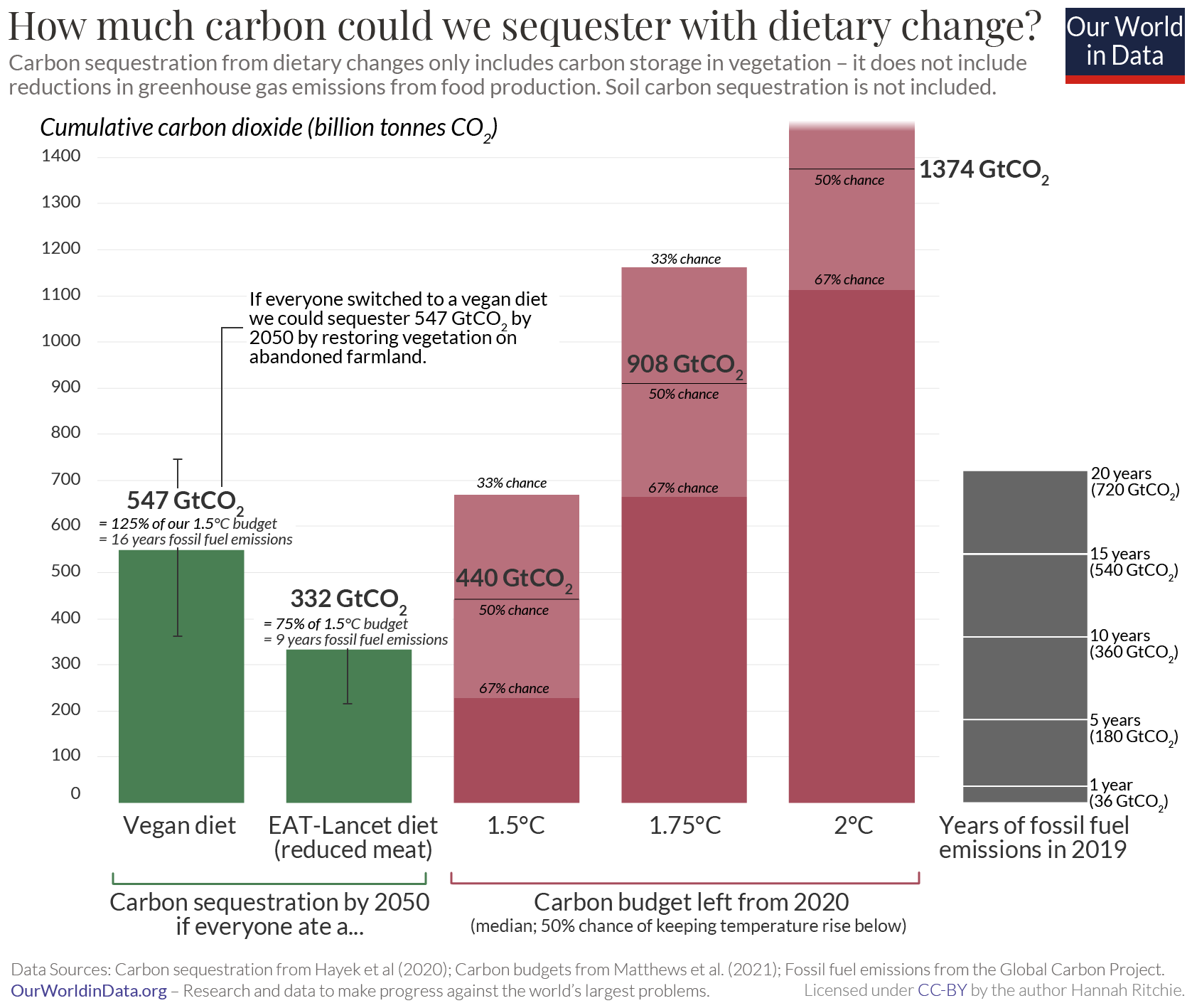
How big would the impact be? The canonical paper on the carbon opportunity cost of animal agriculture finds that a 70 percent reduction in global meat consumption, relative to projected consumption levels in 2050, would remove the equivalent of about nine years of carbon emissions, while a global plant-based diet would remove 16 years of emissions; another study concludes that a rapid phaseout of animal agriculture could freeze further increases in the atmosphere’s warming for the next 30 years, and offset most carbon emissions this century.