Plus: Bear attacks, weather conspiracies and the first-ever phone call.

View this email in your browser   

đź‘‹  Did this email get forwarded to you? Sign up here to get Today, Explained daily.

Today, Explained

the newsletter


March 11, 2026


Yesterday, after listening to the great Today, Explained episode about the mounting cost of the Iran war, I attempted to map out — very messily, and for my own reference — all the products and industries affected by rising oil prices. 

It honestly looked like that meme from It’s Always Sunny in Philadelphia with the deranged investigation board. That’s because crude oil goes into a million things, in some derivative form or another: not just gasoline, or jet fuel, or agricultural fertilizers — but also aspirin and chocolate and roofing tiles and cheap, synthetic sweaters.

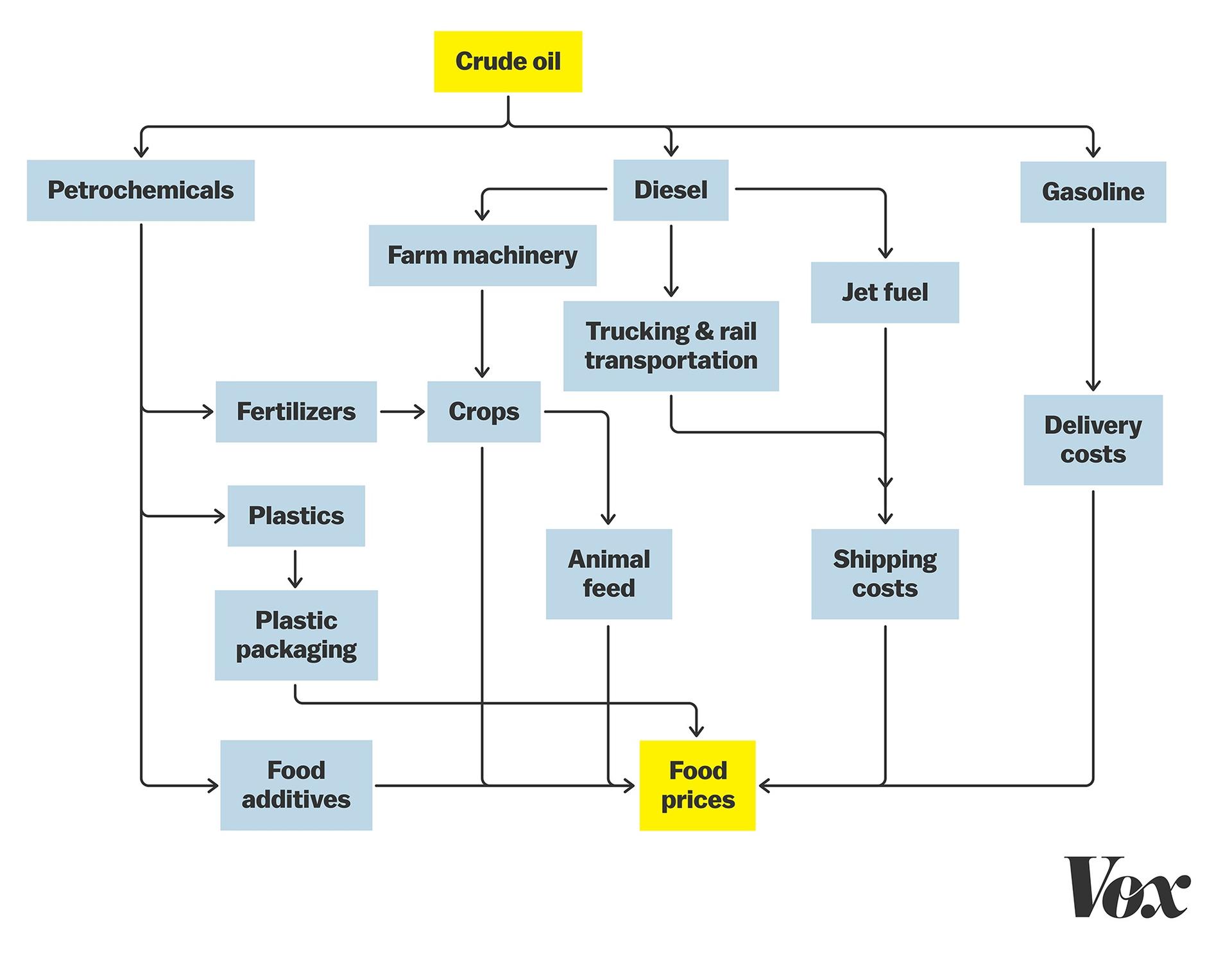
I had wanted to share my string-board with you today, to illustrate a point: that the rising cost of oil could cause economic pain far beyond the proverbial pump. But the tasteful and patient people on Vox’s graphics team informed me that said board was neither easy nor pleasant to decipher. So instead, we’ve isolated one simplified thread from that sprawling map to give you a sense of the knock-on effects the ongoing conflict could cause…and the economic pressure that Iran is now trying to leverage.

Caitlin Dewey, senior writer


Caitlin Dewey, senior writer


⮕ Start here

How the price of oil affects the price of food (...and many, many other things)

The US and Iran are essentially locked in a war of attrition, where both sides are attempting to outlast the other. Iran is enduring literal military strikes on its territory. But the US is taking body blows, too — to its economy. 


That’s because the war has effectively closed the Strait of Hormuz, a narrow channel between Iran and the United Arab Emirates that one-fifth of the world’s oil passes through. And while the US buys very little oil from the Gulf these days, it’s still exposed to the global oil market. Any decline in supply increases prices. 


Most Americans feel this first at the pump. As of Tuesday, the average cost of a gallon of gas had climbed to $3.54 from $3.11 a week prior. But gas is just one piece of a much more complicated economic puzzle. 


“The feed-through from energy prices really hits every consumer item, every intermediate item, every machine, anything manufactured, almost anything you can buy,” The Economist’s Mike Bird told my colleague Noel King. “Almost everything is affected by energy.”


This can be a bit abstract, so let’s look at a specific example: food. Food may not seem especially vulnerable to oil prices, outside the obvious: If gasoline, diesel fuel, and jet fuel get more expensive, then the cost of importing, transporting, and delivering products gets pricier, too.


But the food industry is highly sensitive to energy costs, and the price of transportation is just the start. (“We almost literally eat oil,” jokes the economist Veronika Dolar.)


Foods are commonly packaged in plastic, for instance, which are sometimes created from oil “feedstocks.” Some processed foods contain dyes, additives, and preservatives derived from petroleum. 


Oil is also a significant component in fertilizer, and fertilizer costs are closely pegged to oil prices, Bird said. Rising fertilizer prices could increase the cost of some foods, as well — either directly or by prompting farmers to plant less. 


The economy is complicated and multifaceted, of course. Food prices could take time to go up, and it’s unclear how much they will increase or in which parts of the world. (Among many other factors, the jump in oil prices will likely prompt US producers to drill more — helping turn prices the other way.) 


But you can still see how this generates inflationary pressure, especially as it multiplies across fuel-dependent industries, from travel to construction to household goods. And importantly, as Americans spend more money on things like gas and food, they may have less left for discretionary purchases. 


Iran is betting that President Donald Trump won’t ultimately be willing to stomach that, especially as the midterm elections draw nearer. 


“If you see…prices rise across the economy as they have for the past few years, that is going to be pretty bad for the Republicans,” Bird said. “It's going to be a really, really hard sell.”


Listen to the full podcast episode about the cost of the war here. 


Learn more about OpenWeb
 

⮕ Keep tabs


Boots on the ground: An Iranian Kurdish leader says his people are ready to rise up against the regime, but they need more US support. [Vox]


Weathering a conspiracy: The High-frequency Active Auroral Research Program in rural Alaska is ground zero for a range of fantastical online rumors. [The Atlantic] 


Japan’s bear crisis: The exact mechanics are fascinating and very complicated, but climate change may be to blame for a sudden uptick in bear attacks in Japan. [Vox]


Worse than acid rain: Since US-Israeli airstrikes hit oil depots in Iran over the weekend, residents have reported seeing a black rain full of toxic pollutants. [The Conversation] 


Meet us on Patreon!

The Vox Membership program is getting even better with access to Vox’s Patreon, where members can unlock exclusive videos, livestreams, and chats with our newsroom.

Become a Vox Member to get access to it all.

JOIN VOX ON PATREON
 

🎧 Listen in

Listen

The price of the Iran war

Gas prices are spiking in the US. Markets are crashing. The whole world will pay for this war.


Listen now
 

đź”— Click here

The first-ever phone call — between 29-year-old Alexander Graham Bell and his assistant in the next room — was placed 150 years ago.

Today’s edition was produced and edited by me, Caitlin Dewey. Thanks for reading! 


Are you enjoying the Today, Explained newsletter? Forward it to a friend; they can sign up here. And as always, we want to know what you think. Let us know by filling out this form or just replying to this email. 


Learn more about OpenWeb
FacebookTwitter YouTubeInstagramTikTokWhatsApp

This email was sent to segal@instatrac.com. Manage your email preferences or unsubscribe. If you value Vox’s unique explanatory journalism, support our work by becoming a Vox Member.


View our Privacy Notice and our Terms of Service.


Vox Media, 1701 Rhode Island. NW, Washington, DC 20036.
Copyright © 2026. All rights reserved.