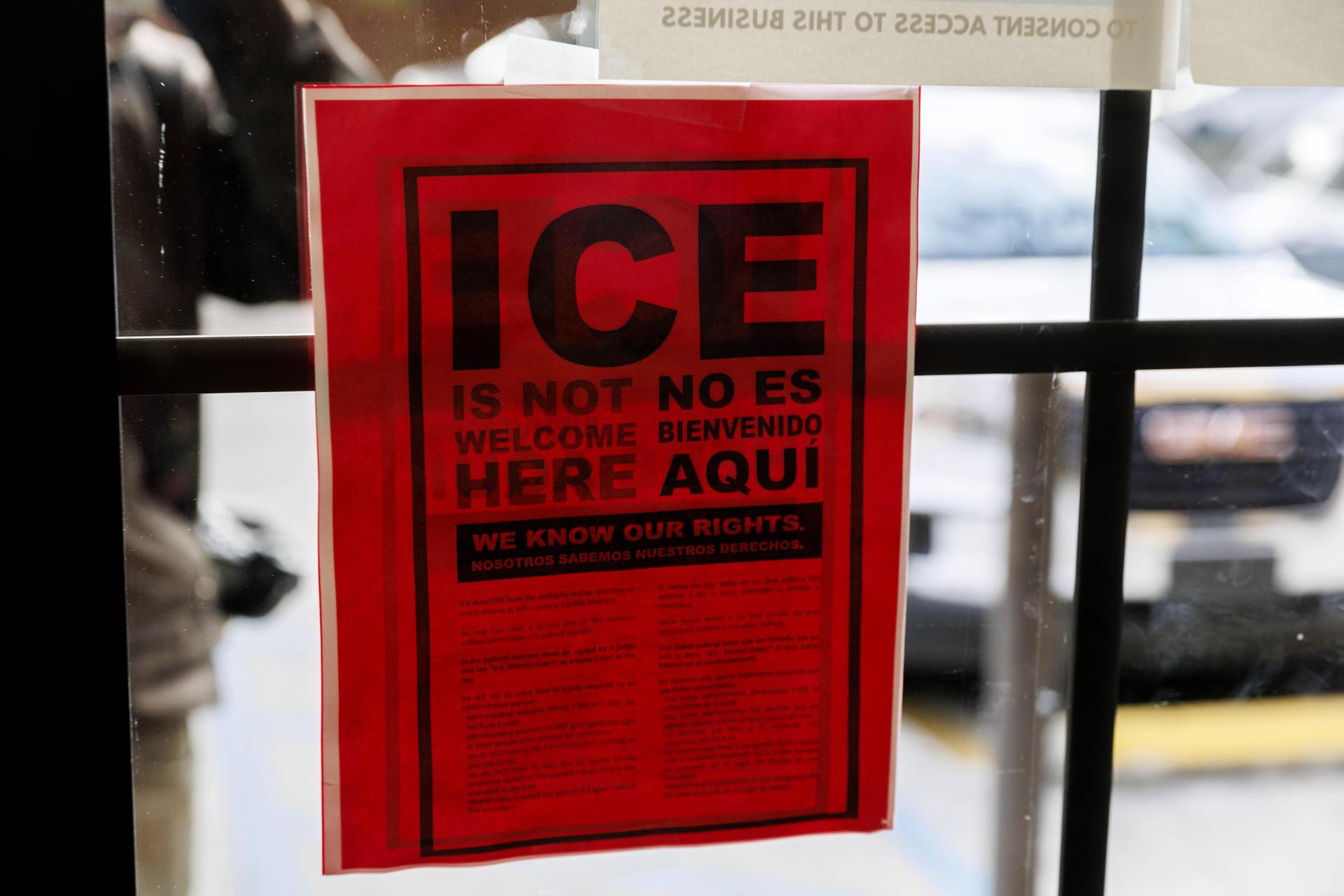
Two things happened this week that reveal how quickly the politics of immigration enforcement are shifting.
First, Republican Sen. Jim Justice of West Virginia, a staunch ally of President Donald Trump, urged the administration to dial back its enforcement push. “Before you know it, you get people that get carried away in their job and whatever it may be, and all of a sudden, then you're dragging people away that have lived on your street corner for 15 years,” Justice told Politico this week. “I don't know that we need to be doing that stuff.” And he’s not the only red-state Republican who’s been pushing back on ICE lately, including some facing voters in tough races next month.
The second thing flew under the radar: Sen. Jon Ossoff, the Georgia Democrat running for reelection who has also been floated as a 2028 presidential candidate, struggled to explain himself when a reporter confronted him on camera about his vote for the Laken Riley Act in January 2025. Passed within days of Trump's inauguration and signed nine days into his second term, the law requires ICE to detain undocumented immigrants who are merely arrested for or charged with theft-related crimes, before any conviction.
In the exchange with a reporter from Drop Site News, Ossoff talked about his Senate work investigating alleged ICE abuses, but didn't directly address his vote after being asked if he regretted it. “Laken Riley was my constituent and what happened to her should happen to no American, to no person in this world,” Ossoff said. “I think that immigration enforcement should be focused on those who are convicted or charged with serious crimes.” He excused himself to walk into a meeting as the reporter pressed him on whether the law undermined due process.
In both cases, you see changing winds of electoral politics. Back in 2025, when Ossoff and 11 other Senate Democrats joined Republicans in supporting Trump's immigration bill, they implicitly validated Trump's premise on immigration enforcement: that not only was the border out of control, but that there also needed to be new efforts to step up interior enforcement through expanding agencies like ICE. In the year-plus since that vote, Trump has hired more ICE officers, launched sweeping raids in cities like Minneapolis, Chicago, and Los Angeles, and fueled a cauldron of chaos that's led to shootings across the country. Politically, it has now put Democrats like Ossoff in a pickle, one that will matter more the closer we get to 2028.
How do you explain giving more immigration powers to a Stephen Miller-led White House? How can one argue you couldn't have seen this coming?
In some ways, you can understand the political logic of the time. Ossoff, who is running in a state Trump carried, and many of the congressional Democrats who supported the Laken Riley law were in competitive races, and Democrats left the 2024 election thinking they had misread the electorate on the issue, particularly after Latino voters swung hard toward the right. But given what's happened since, it's clear many congressional Democrats made a familiar mistake: prioritizing political triangulation over standing on their values of protecting marginalized communities.
Take a look at some of the Democrats who have already had to walk back their votes. In the Democratic primary for Minnesota's open Senate seat, Lt. Gov. Peggy Flanagan made US Rep. Angie Craig's vote for the law a key focus of her campaign, calling it "disqualifying." The attacks were so effective that Craig eventually expressed remorse, saying, “I wanted to be honest with the people of Minnesota. I will tell you when I get it wrong, and I got that one wrong.” Craig lost the August 11 primary to Flanagan.
Maryland's April McClain Delaney, another congressional Democrat, also said she regretted her vote: “I will say that this was in the beginning of my term. And I never thought that ICE immigration and the horror of what has happened would happen.” (She survived her primary, defeating David Trone by 6 points.)
It's easy to see where the buyer's remorse is emanating from. Trump's ICE is broadly unpopular. And as we've talked about on this Substack and in our reporting on America, Actually, Trump is doing worse and worse with Latino voters, with both prices and immigration enforcement driving the slide. A Hart Research poll for TelevisaUnivision of 1,500 Latino registered voters in battleground House districts (August 6–17) found 63 percent disapprove of Trump's job performance and 62 percent disapprove of his handling of immigration enforcement and deportations. Sixty-four percent view ICE unfavorably.
When I recently talked to Stephanie Valencia of Equis Research, she said this:
“The people who feel most regretful who voted for Trump in 2024 are most regretful because of immigration. They feel like there was a broken promise there. Like, they were told he was gonna focus on the border, which everybody agreed was chaos, and he was gonna focus on violent criminals and serious threats, and at the end of the day, he has not complied with that.”
But while the shift in public opinion helps explain the elected officials' political logic, it doesn't change the material harm of their votes. Just this week, ICE announced plans to hire 5,000 more employees, most of them deportation officers, by the end of the year as enforcement continues to ramp up.
And these raids have a lasting effect on targeted communities, like in Maine, the Chicago area, and Texas. It's the No. 1 issue that has come up in my conversations with local reporters. The chief architect of this chaos is the president, but make no mistake: Trump had help from shortsighted Democrats.