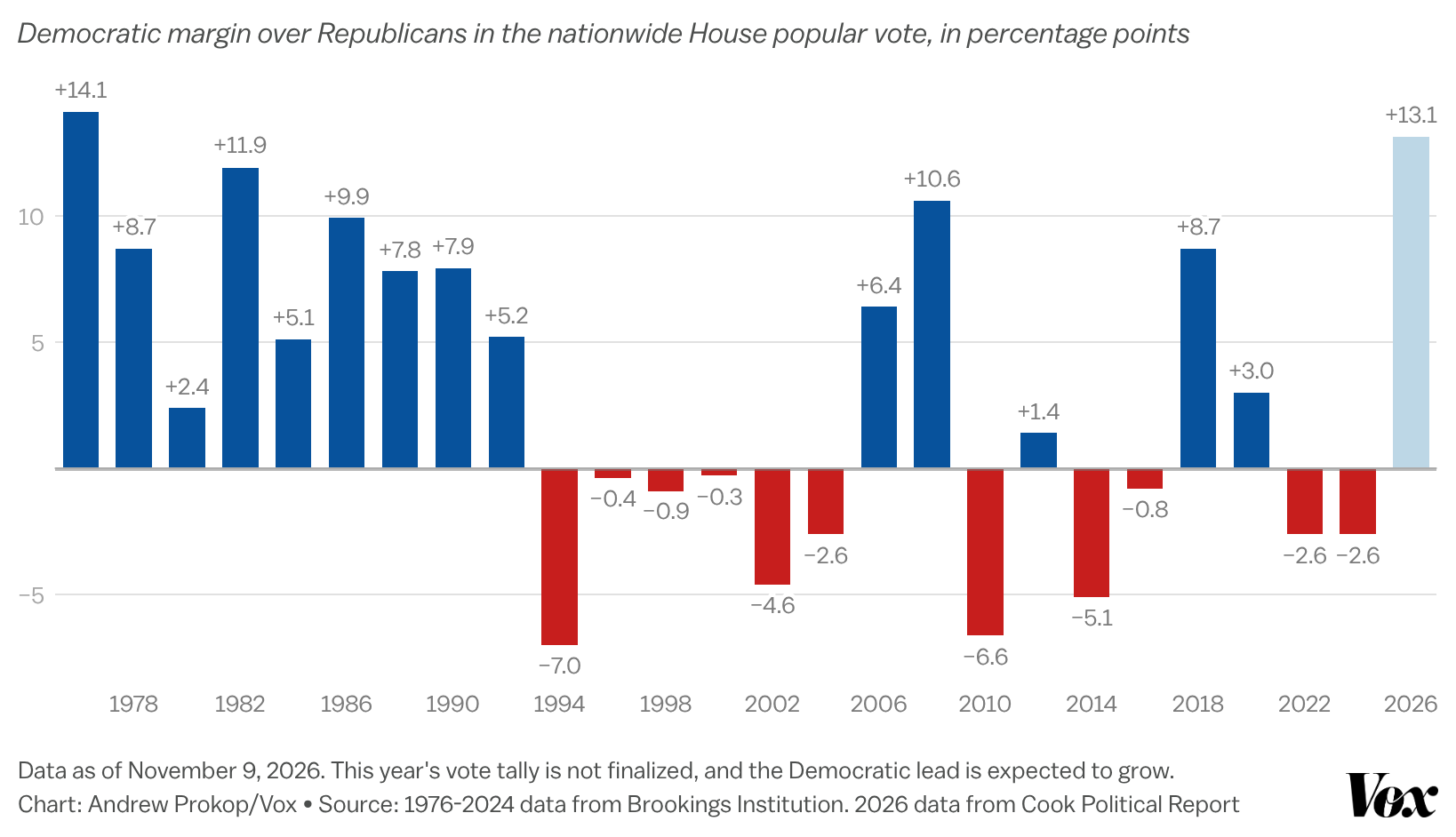
You have to go back to the Watergate era to find a blue wave as big as last week’s. The year was 1974, the vibes were alternatingly grim and groovy, and American voters were looking for change after the scandals of Richard Nixon’s presidency.
Democrats already controlled the House and the Senate, but that year’s midterms ushered in a class of even younger and more liberal lawmakers. And these so-called Watergate babies came to play: They helped extend a run of post-Watergate reforms that opened up congressional proceedings, required financial disclosures from senior officials, and strengthened oversight of federal agencies.
But 52 years later, the 1974 blue wave isn’t exactly remembered as an unrivaled success — for the Dems or for democracy. Ronald Reagan became president just six years later, and both he and other presidents since have weakened the reforms of the mid-’70s.
The push to make government more transparent — by inviting television cameras into hearings, for example — also arguably made Congress a more polarized and confrontational place as lawmakers were newly incentivized to be less candid, more performative, and more rigid in their ideology.
Other, more conservative waves have also run up against the limits of congressional power. The political scientist Robert A. Strong points to Newt Gingrich’s 1994 “revolution,” which ended four decades of Democratic House control.
But that Republican sweep, far from delivering Gingrich’s vision of a dramatically smaller government in one fell swoop, triggered bitter confrontations with President Bill Clinton, including debt-ceiling standoffs and government shutdowns. When major legislation did become law, it required compromise: A sweeping welfare overhaul only passed after Clinton vetoed prior versions twice.
In some ways, these challenges are fairly intuitive. Even when one party controls the White House and both chambers of Congress, it still has to reconcile competing factions and navigate procedural hurdles in the Senate. And when control of those branches is split between parties, as it will be soon, you end up with even bigger obstacles — like a veto-happy president.
Given that, Democratic voters might want to temper their expectations just a little. As my colleague Andrew Prokop laid out earlier this month, Democratic bills will — even in this new, blue environment — likely only pass through compromise or fierce confrontation.
Making electoral history is one thing, as history itself shows. But making legislative history is an altogether tougher proposition.