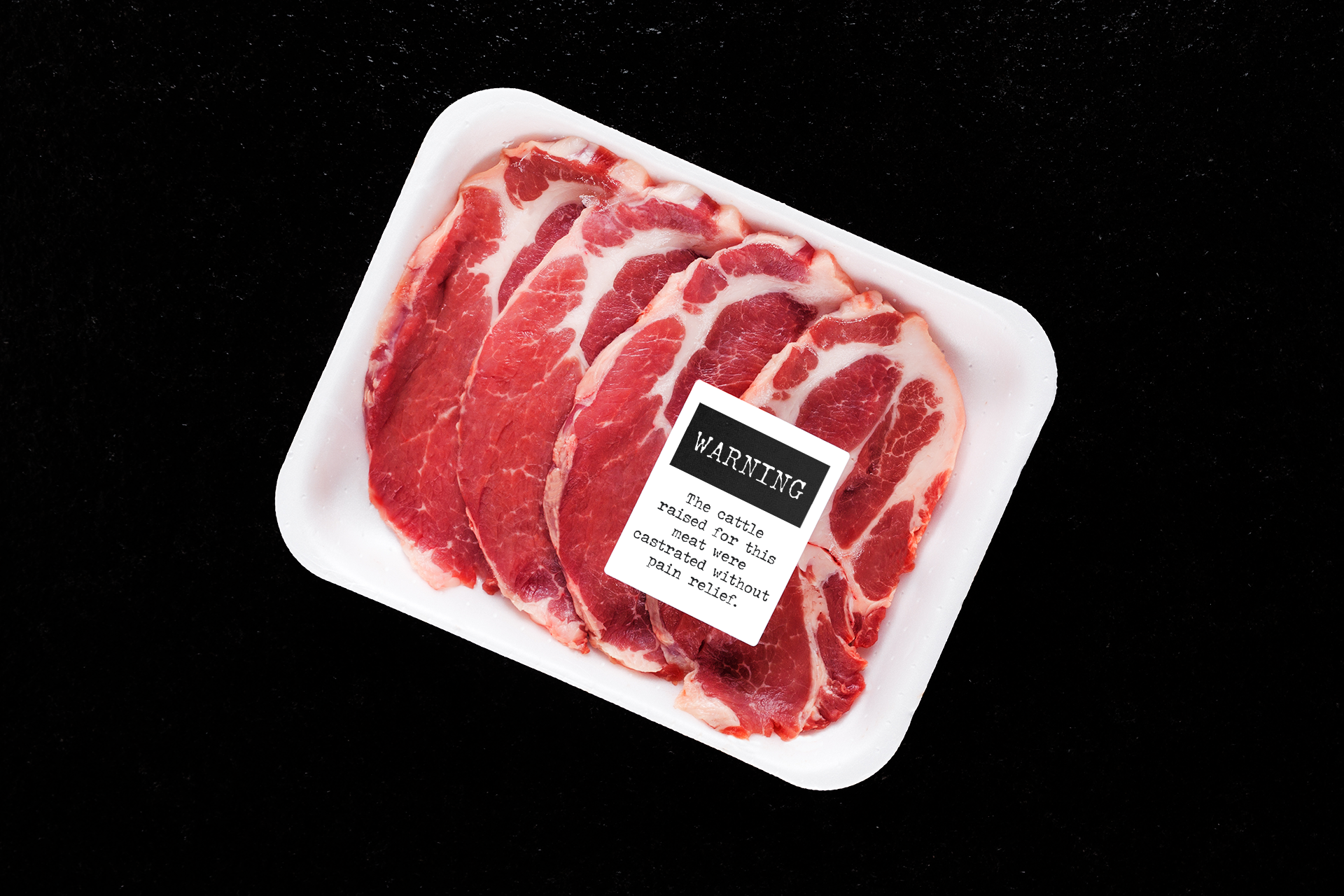
Meat production is a high-volume business, with tens of billions of mammals and birds — and over 1 trillion fish — churned through the system each year. Administering pain relief to the animals subjected to these painful procedures would be the least meat companies could do, but most don’t because it would cost them a little extra time and money.
And even when performed with pain relief, such procedures remain cruel — removing animals’ tails, horns, and testicles, or shortening their beaks and teeth, reduces their ability to communicate or perform basic biological functions.
Switzerland is one of a handful of countries where farmers are required to give animals pain relief before these painful procedures. But the small country still imports plenty of meat and other animal products from abroad. Swiss animal advocates have long advocated for banning imported products that come from animals mutilated without pain relief, but Swiss policymakers have rejected that idea and instead settled on increased transparency in labeling as a compromise.
It’s an unusual law, and although it falls short of what animal advocates want, it’s refreshing to see a country take this step toward transparency.
Switzerland’s disclosure requirement pierces the veil of the shrink-wrapped slab of meat consumers see in the grocery store or prepared in dishes at restaurants, suggesting that meat is simply an inanimate product rather than the flesh of a once-living, feeling creature who suffered. A mere disclosure provides no respite from that suffering, but it’s something. Because in the US and around the world, meat, milk, and egg companies go to great lengths to conceal the horrors of animal agriculture from the public.
By requiring food companies and restaurants to slap what amounts to a warning label on their products, Switzerland is effectively treating meat produced with particularly cruel yet common practices as a vice — much like many countries do with tobacco products. Whether or not these labels steer consumers away from meat or push meat producers to change their practices might hold important lessons in what works to reduce animal suffering.
The double bind of the meat industry’s concealment and consumers’ willful ignorance
Mutilation without pain relief is, of course, just one of a litany of welfare issues that farmed animals suffer from birth to death. Animals raised for food are often overcrowded, forced to live in their own waste, exposed to disease, confined in cages, violently and artificially inseminated, roughly handled, inhumanely transported, and bred to grow bigger and faster, causing health and welfare issues. Problems at slaughterhouses abound, too.
“Significantly more products and production methods should be subject” to Switzerland’s new labeling regulations, Vanessa Gerritsen, a lawyer for the Swiss animal advocacy organization Tier im Recht, told me in an email.
The vast majority of the world’s farmed animals are raised on factory farms with standard practices that would be illegal animal cruelty in many countries if done to a dog or cat. Yet most consumers — at least in the US — believe they don’t buy animal products from factory farms.
Some of that disconnect can be attributed to industry deceit. Meat industry trade groups in the US and abroad have successfully lobbied for laws that make it a crime for activists to document animal cruelty on farms. And in the US, meat companies are allowed to claim just about whatever they want on their labels and in advertising. That’s led to extensive “humanewashing” in which brands mislead consumers into believing their animals are treated decently.
But there’s also the problem of willful ignorance: Some research has found that consumers prefer to avoid information about meat production.
Switzerland’s new regulation represents a massive experiment in pushing back against this inclination, forcing people to think about the cruelty that goes into their pork chops and egg omelettes at a particularly important time: the moment they’re deciding what to eat at a restaurant or buy at a grocery store.
But will it be enough to actually change what people eat? “Hard to say,” Alice Di Concetto, founder and executive director of the European Institute for Animal Law & Policy, told me in an email. “Studies tend to show that consumers base their purchasing choices almost exclusively on price.” But it could have an impact on the decisions of restaurants and grocery stores, she said, “who might be reluctant to offer these products, anticipating that they won’t sell well as a result of carrying a negative claim on them.”
Switzerland implemented a similar law in 2000, requiring disclosure labels on imported eggs from producers that cage their hens (it was already illegal to cage egg-laying hens in Switzerland). After that law, Gerritsen told me, imports significantly declined.
Di Concetto also pointed to a labeling law in the European Union, which requires that egg cartons on grocery store shelves include a code that corresponds to a specific production method, such as caged, indoor, outdoor, or organic. Di Concetto credits these egg-labeling requirements for helping initiate the EU egg industry’s transition to cage-free production. But, she said, “it’s not so much that consumers wouldn’t buy caged eggs. It’s mostly due to manufacturers not liking the idea of selling products that indicated something so detrimental.”
The new Swiss law, though, will require disclosures far more direct and visceral, and harder for the public to ignore.
At bare minimum, for consumers to make more humane choices — whether that means eating less meat or buying from farms that avoid some of the cruelest factory farm practices — they at least need to be informed. Right now, meat, milk, and egg labels tell consumers little about animal treatment or actively lie to them. Switzerland’s experiment will soon show us what happens when that’s forced to change, if only a little.
— Kenny Torrella, senior reporter