Hey readers,
Kenny here.
More than 90,000 wild horses and burros make their homes on public lands in the Western US, and each year, the federal government rounds up thousands of them. It typically holds them in large pens or pastures for months or years until they’re adopted or die — on the rationale that their wild population levels are just too high for the land to sustain.
But not all captured horses share these fates: Some are sold, via a legal loophole, to Canadian slaughterhouses and processed for meat, most of which is exported to European and Asian markets.
It would technically be illegal to slaughter these animals for meat in the US. But according to a recent New York Times investigation, legal workarounds have enabled livestock buyers — who’ve purchased the wild horses for as little as $25 apiece — to funnel them through intermediaries and ship them north where they can sell to slaughter for up to $750 each.
|
These sales have been going on for decades, though they’ve accelerated during President Donald Trump’s second term.
Wild horses, also known as mustangs, are an American icon, and they are squarely in the “not food animals” category for most people in the US. But one food animal industry has been pushing for increasingly intensive roundups — and even slaughter — of these wild horses, and has escaped most popular attention on this issue: the beef industry.
The Western US is a giant cattle ranch — and ranchers say horses are bad for their business
Ancient horses roamed North America for millions of years before going extinct some 9,000 years ago; the wild horses scattered across the Western US today are the descendants of animals introduced by European colonists in the 1500s. These wild equids now number around 93,000 on public lands and are concentrated in Nevada, Arizona, California, and Wyoming.
The Bureau of Land Management determines how many wild horses and burros can live in particular management regions, and when those levels are exceeded, they can remove some of the animals.
There are, of course, other animals grazing these same public lands: several million privately owned cattle. About 250 million acres of BLM and National Forest Service land — 13 percent of all of the contiguous US — is made available to ranchers to graze their cattle on natural forage. This often puts cows in direct competition with wild horses and burros, whose populations can grow quickly — and damage vegetation and water bodies (as cattle do, too). So BLM determines how many of these wild animals can live in a management region based on how much forage is available to support them, other wildlife, cattle, and to preserve the land.
Wild horse advocates argue that the way BLM determines “appropriate” horse population levels is designed to heavily favor cattle ranchers, ensuring there’s plenty of forage for their livestock. These ranchers lease grazing rights from BLM at the dirt-cheap rate of just $1.69 per animal per month, which some critics say makes public lands essentially a massive subsidy for these ranchers, providing cheap land and food for their cattle.
|
The US’s largest cattle industry group, the National Cattlemen’s Beef Association, and its public lands sister organization, the Public Lands Council, advocate for more aggressive wild horse and burro management.
The groups call for legalizing horse slaughter in the US and increasing BLM and Forest Service budgets specifically so the agencies can continue their, as the cattle industry organization describes it, “aggressive” wild horse removal schedule. The National Cattlemen’s Beef Association didn’t respond to a request for comment for this story, and neither did the Public Lands Council.
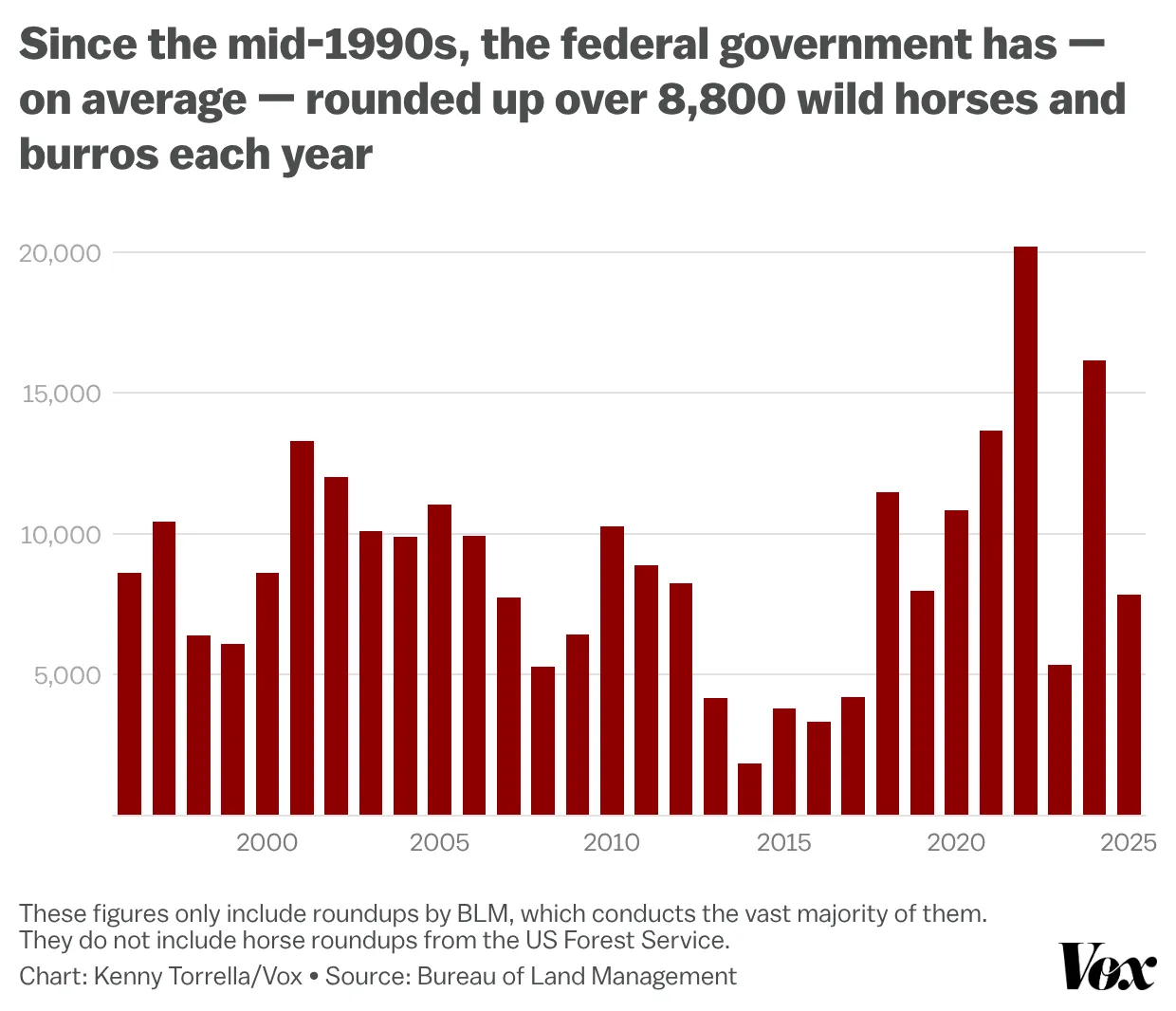
On average, since the mid-1990s, the BLM has captured around 8,800 wild horses and burros on public land per year. It’s usually done this by baiting the animals with food and trapping them, or flying helicopters over herds and driving them into chutes to be trapped. Some die during the roundup process, or later from injuries they incur during roundups.
After that, the animals are housed in pens or pastures until they’re adopted, sold, or die of old age, injury, or disease. There are currently about 58,000 wild horses and burros held, which costs taxpayers $100 million to manage annually.
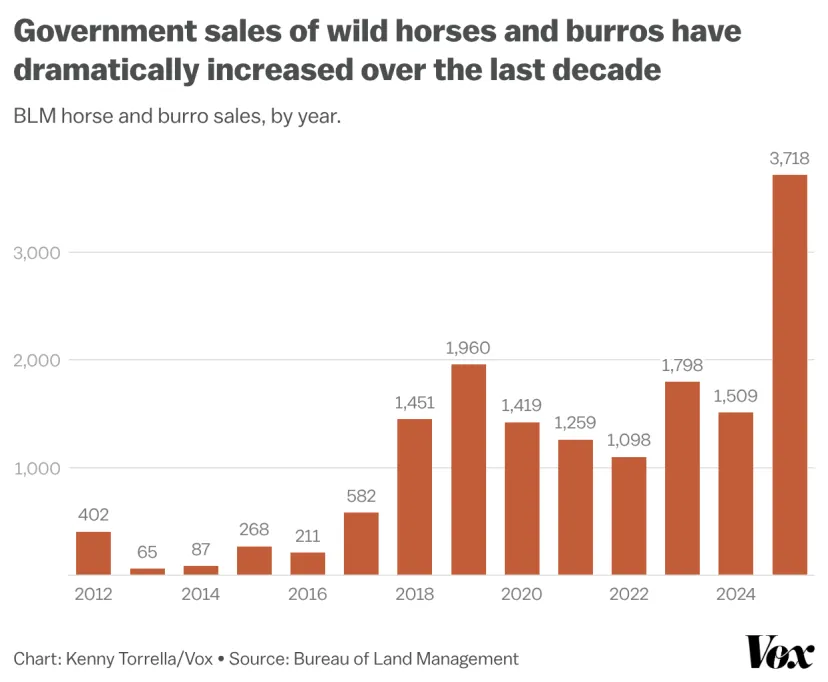
But the number of wild horses sold — rather than adopted out or held — has been ticking up; in 2013, it was as few as 65. In 2024, some 1,500. And last year, it was more than 3,700. It’s unknown just how many of these purchased animals, in any year, wound up in slaughter plants. Other sold animals are often used for activities like trail riding, ranch work, and equine competitions.
In an email to Vox, a spokesperson with the Bureau of Land Management denied the slaughter allegations: The BLM, a spokesperson told me, “does not send wild horses or burros to slaughter. No loophole exists that would allow people who adopt or buy wild horses to ever sell animals directly or to middlemen for slaughter.” A common-ground solution: put more wild horses on birth control
Some conservation nonprofits — along with former BLM employees — allege that BLM has been overly deferential to cattle groups and the ranchers they represent at the expense of wildlife. Sometimes there are even clear conflicts of interest within the Bureau. For example, earlier this year, a top Trump appointee within the Department of the Interior — which the BLM sits under — said at a congressional event that she has been involved in discussions to ease grazing limits and habitat protections; she and her husband own companies that graze cattle on about 250,000 acres of public land managed by the BLM.
Wild horses and burros aren’t the only species in the crosshairs of the cattle industry and the federal government. Some cattle groups, for example, want to restrict bison grazing around Yellowstone National Park — out of fear they’d spread a bacterial disease to nearby cattle, which has never been documented to occur — and support stripping gray wolves’ Endangered Species Act protections because they (very occasionally) kill grazing cattle.
And as I’ve previously reported, the US Department of Agriculture kills about 2 million wild animals — including over a million starlings and nearly 60,000 coyotes — a year, primarily in the name of protecting livestock and the crops fed to cattle, chickens, and pigs.
Perhaps the most promising route to reducing the number of horses rounded up, housed, and potentially sold to slaughter lies in reducing the number of wild horses and burros born in the first place. For that, Patricia Miller, executive director of the nonprofit American Wild Horse Conservation, told Vox that she’d like to see BLM prioritize birth control for wild horses as a more humane alternative. Cattle groups support increased birth control, too.
In 2019, a coalition of cattle industry and animal welfare groups — which AWHC didn’t join — agreed on a proposed compromise plan, called the “Path Forward,” to increase BLM funding to both aggressively increase wild horse roundups and deploy more wild horse birth control. The following year, Congress increased BLM’s wild horse and burro management budget by $21 million and has steadily increased it since. Subsequently, BLM has ramped up fertility control actions, which are both time- and resource-intensive, but it’s accelerated wild horse roundups at a much faster clip. Miller says BLM could spend up to $11 million on fertility control this year but isn’t mandated to; she and her group are lobbying to make it so. In 2024, BLM spent around $5 million on fertility control.
“We use fertility control wherever it can work,” a BLM spokesperson said over email.
Doubling down on fertility control would go a long way to improving wild horse and burro management in the West, and it could reduce the number held in indefinite captivity or sent to slaughter. But it also leaves open larger questions about how public lands are managed in the US. |
|
|
|
|
Kenny Torrella Senior reporter | |
|
|
| Kenny Torrella Senior reporter |
|
|
|
CAN'T STOP THINKING ABOUT... |
|
|
|
| Title: Future Perfect fellow
What I cover: Mostly why women are not small men and shouldn’t be treated as such, especially in medicine and healthcare
Current side quest: A tomato-crawl to eat my way through seasonal tomato treats in town before summer ends. |
|
|
|
In yet another episode of “we really don’t understand female anatomy,” scientists have rediscovered a structure in the ovaries.
Enter the rete ovarii, a structure directly attached to our ovaries. Over the years, researchers never reached a consensus on its function, and it eventually disappeared from textbooks. But now, new research hints that it might actually be important.
A series of experiments from Dr. Dilara Anbarci and colleagues at Duke University used 3D imaging and protein analysis to show that the rete ovarii might help to regulate and maintain the ovaries. The team found that fluids injected into part of the rete ovarii might act like a channel for transporting fluids from the environment around the ovaries into them. Along with other elements of the team’s work, this suggests that the rete ovarii help the reproductive system stay sensitive to changes in the body. A separate study from Anbarci and colleagues also indicated that the rete ovarii may have a hand in fertility, although it’s hard to say what, exactly, that role is.
For now, at least, this new data just shows that “something is going on,” as developmental biologist Serge Nef of the University of Geneva told Science News. We can hope, however, that renewed interest in the rete ovarii will lead to more research and investment in the female anatomy and reproductive health. As Francis Bacon declared at the dawn of modern science, “knowledge is power.” When it comes to our reproductive organs, we have too few of either, but research like this might offer us more of both.
|
|
|
|
The Vox Membership program is getting even better with access to Vox’s Patreon, where members can unlock exclusive videos, livestreams, and chats with our newsroom.
Become a Vox Member to get access to it all. |
|
|
|
YIMBYism meets its biggest challenge yet: A wildfire |
Wildfires leveled thousands of homes in California. Now the state could block even more from being built. |
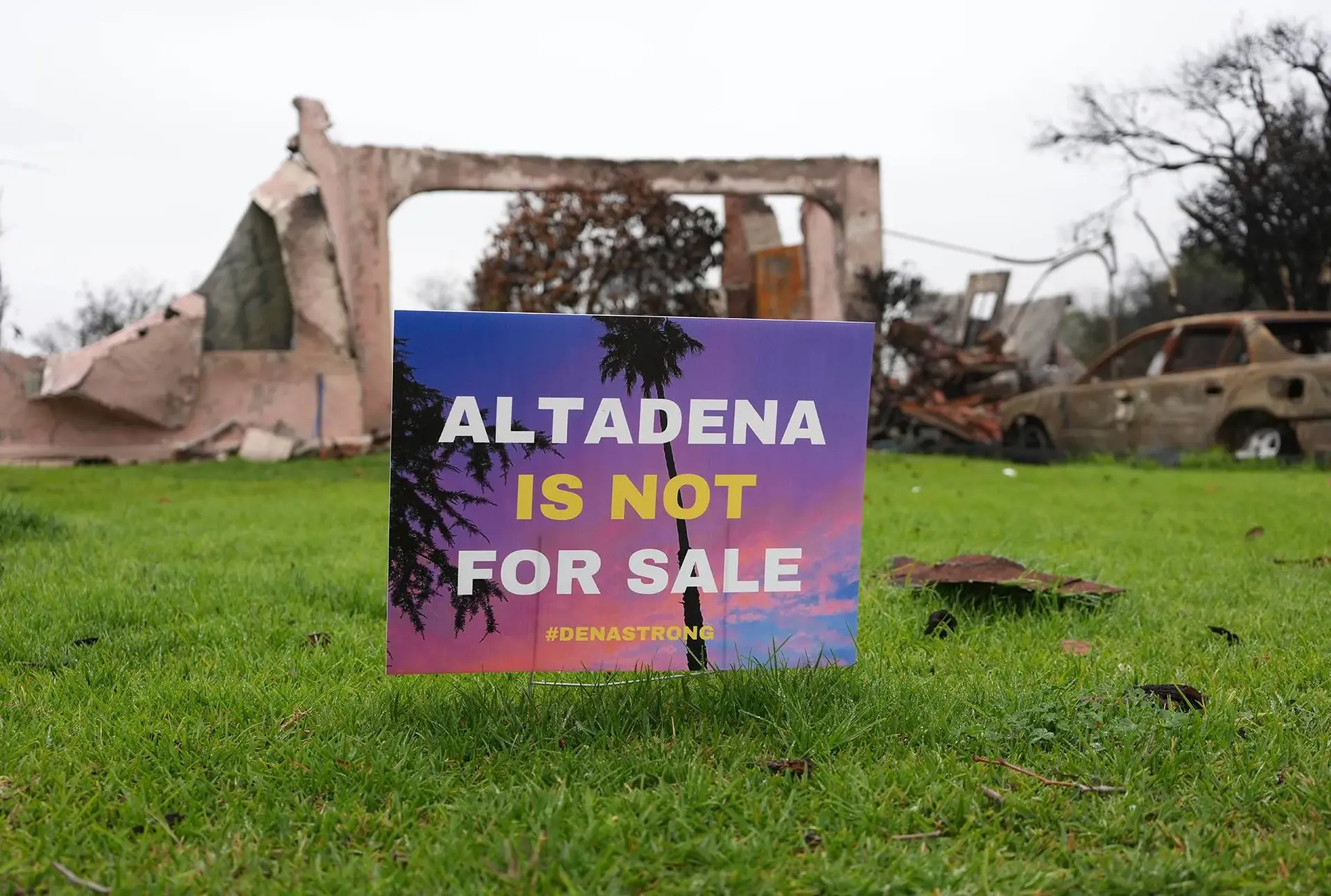
When a wildfire destroys a neighborhood, it is hard enough to rebuild. But what happens when the question becomes what to rebuild? In California, that tension has come to a head recently as the pro-housing state faces local backlash from residents fighting to keep new, high-density housing out of their old neighborhoods.
In her latest article, Future Perfect senior reporter Marina Bolotnikova reveals how this fight illuminates something bigger under the surface of American housing politics: the idea that every transaction is a zero-sum one. But Marina shows that it’s possible that many of these new housing solutions can be a win for potential new residents as well as for those trying to rebuild their lives. —Katherine Courage, deputy editor, Future Perfect |
|
|
|
⭐ ONE WAY TO DO GOOD THIS WEEK |
Last week, devastating floods and landslides hit the Nepal-Tibet border. The resulting torrent of ice, mud, and water laid out a 40-mile path of destruction, washing entire villages away. The death toll is currently around 900, and the number of missing persons has surpassed 4,000.
The region is in desperate need of any humanitarian aid and relief it can get.
There are multiple ways you can help, including by supporting organizations already operating in Nepal, such as All Hands and Hearts, which is providing food and shelter supplies, and Nepali NGO EcoHimal, which you can support through their Instagram page. Global Giving is currently raising funds for multiple emergency relief projects for the floods, from medical aid to supporting rural outreach. –Ananya Rupanagunta, Future Perfect Fellow
|
|
|
|
Want more Future Perfect in your inbox? Sign up for more newsletters here. Need advice? Submit a question to Sigal Samuel's advice column Your Mileage May Vary.
|
|
|
|
Today’s edition was edited by Jacob Brogan and Katherine Courage. We’ll see you Friday! |
|
|
|
|