To kick this series off, I asked Astead to imagine a hypothetical world in which he hadn’t followed politics since 2024. (An outlandish counterfactual: Astead is acutely plugged into politics.) But in this alternate universe, I asked, what would surprise him most about 2026?
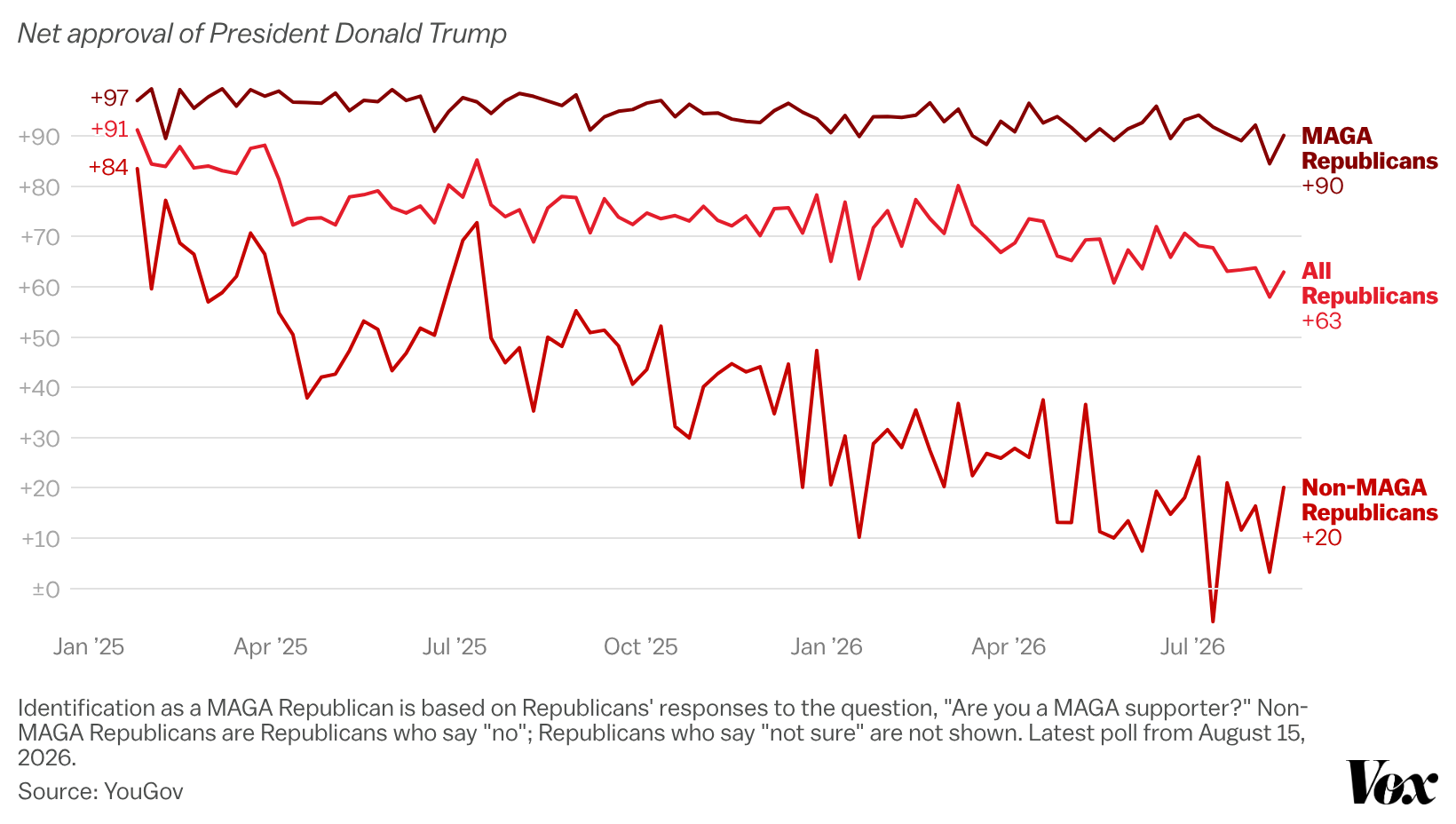
Easy, he said. The GOP’s disillusionment with President Donald Trump, who remade the party in his image.
Let’s put some numbers on that phenomenon, to start. Trump’s approval rating has dipped to record lows, even among Republicans. According to an NBC poll conducted in mid-September, just 4 in 10 Republicans strongly approve of Trump’s performance, down 11 percentage points from the spring.
Republicans have soured on Trump over his handling of the economy and attacks on Iran, which violated his promise to keep America out of foreign wars. Trump’s delayed release of the Epstein files also fueled distrust in his base by exposing his own ties to the dreaded “elite insiders.”
In response, some Republican candidates have worked to distance themselves from Trump, even defying him in campaign ads. But it’s unclear whether that tactic will win over disillusioned or disengaged Republicans. If enough stay home, Astead said — especially with Democrats eager to vote — Democrats could flip the House and/or Senate and make Trump’s last years in office far more difficult.
And speaking of Democrats…they’re also undergoing a major transformation after their 2024 presidential defeat. That loss disproved their previous theory of Trump-era politics: namely, that Trump’s rise was an aberration that competence, decency, and normalcy would eventually overcome.
By contrast, today’s Democrats want a party that “fights,” Astead told me. “The open question is who they're fighting: The oligarchy? Big Tech? The Billionaire/Epstein class? Trump's Republican Party?”
Democrats face ideological questions, too. Since 2024, voters have lost trust in the establishment and in party leaders’ ability to pick the best candidates; left-wing candidates have thrived in that vacuum. It’s pretty wild, when you think about it, that a Muslim democratic socialist in New York ranks among America’s most popular Democrats.
For both parties, then, November 3 is a test of their respective visions for America. Not just between the parties — as in, Republicans vs. Democrats — but within them, as well. That, in turn, will help determine the rest of Trump’s presidency…and the 2028 presidential election.
But it’s only October 1. Let’s not get ahead of ourselves.
➨ Races to watch: Michigan’s Senate race, where progressive Democrat Abdul El-Sayed faces Republican Mike Rogers; Florida’s 27th District, where Republican María Elvira Salazar publicly broke with Trump; and the Nebraska, Idaho, and South Dakota’s Senate races, where independent candidates will test both sides’ exhaustion with the two-party system.
➨ More from Vox: