There was a time not so long ago when “Data Center Dave” might be a neutral nickname for the well-meaning IT guy at work. Then Americans soured on AI and the hulking, cavernous warehouses that supply its computing power.
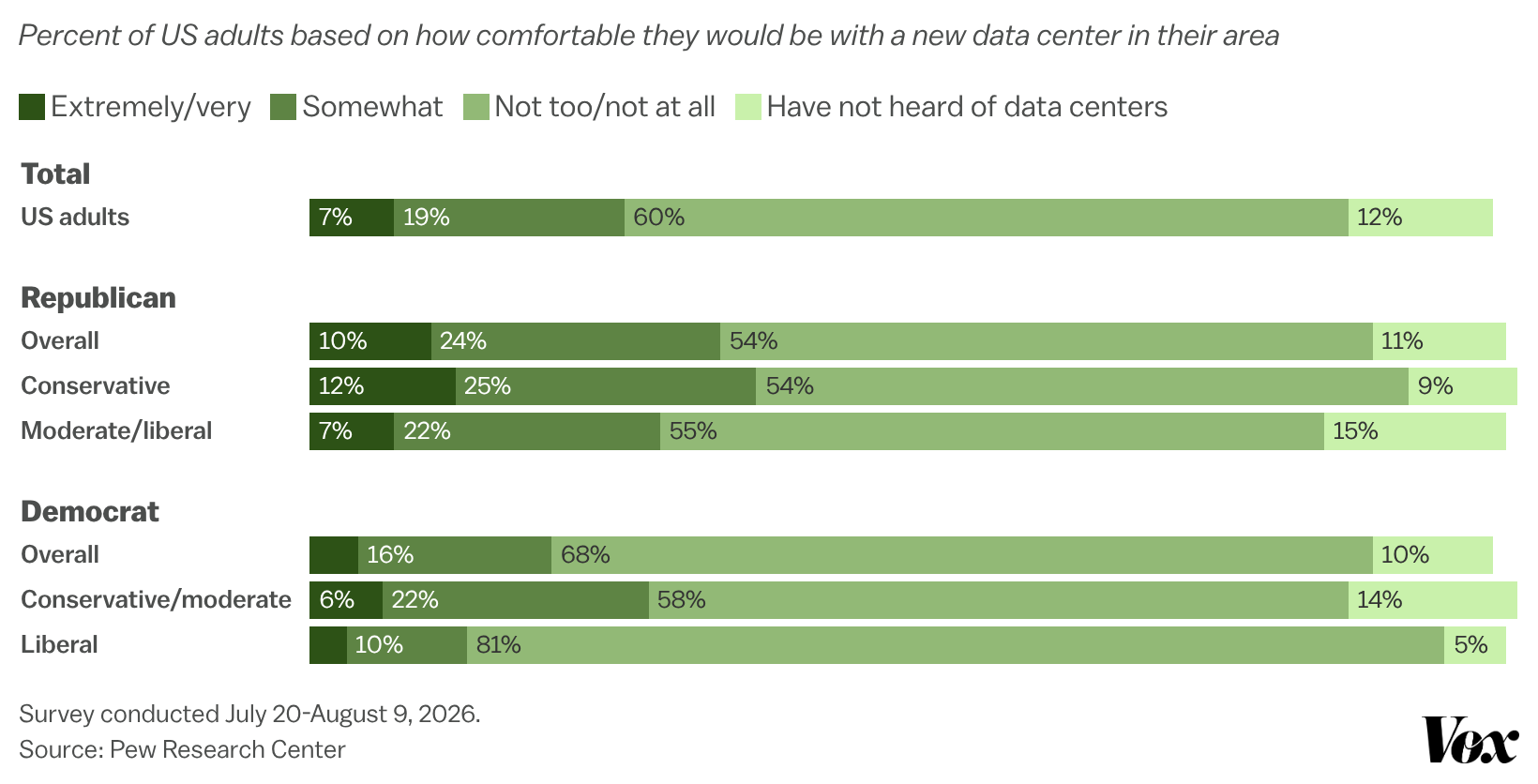
The hostility crosses geography and party lines. At first, opponents focused on noise, water use, and energy costs — quality-of-life concerns for nearby residents. But increasingly, even voters far from these projects grew leery of them.
Too often, the public got little say in where data centers were built and on what terms. And as Vox’s Marina Bolotnikova reported over the summer, the construction boom gradually became a stand-in for broader fears about artificial intelligence. Would AI cause mass unemployment (…or worse, mass extinction)? Would it widen the gap between rich and poor? And do politicians cater to business interests over the needs of ordinary people?
Without clear answers to those questions — let alone a rigorous plan to address AI’s fallout — many voters channeled their unease into stopping, or slowing, data center development.
Candidates have reacted by “falling over themselves to sound tough on data centers,” Washington Post data reporter Jeremy Merrill recently told Vox’s Noel King. He analyzed thousands of social media posts and newsletters to see how elected officials are talking about data centers, and the answer is: not positively!
Some candidates in high-profile races have backed policies that would keep data centers from raising household energy bills. Others have called for ending the facilities’ tax breaks and subsidies or requiring public notice before new construction. Strikingly, both Republicans and Democrats have supported these types of proposals…and both Republicans and Democrats have sought to tar their opponents as “Data Center Daves” of one kind or another.
I asked my colleague Andrew Prokop, who covers politics, if many races will actually turn on this. He told me: “Data centers have been a major theme in several races, particularly governor's races where one of the candidates has taken past pro-data center positions.”
But even when voters say they oppose data centers, few list the issue among the most important concerns determining how they cast their ballots. In Ohio, for instance — a hub for both data-center development and the grassroots movement opposing it — only 3 percent of voters named data centers as the top issue driving their vote. And that’s the highest share in the country.
Andrew points to the Democratic gubernatorial primary in Wisconsin, where “Data Center Dave” triumphed over state Rep. Francesca Hong, an outspoken data center critic. “That just goes to show that data centers don't necessarily crowd out everything else,” Andrew said.
Still…that’s just one race. And voters’ hatred of data centers has only grown since.
➨ Races to watch:
➨ More from Vox: